Wednesday, September 25, 2013

Bounty Records of US Colored Troops, in Arkansas Freedman's Bureau Records A - D

Ledger from Little Rock, Arkansas Field Office
Bounty Register
Roll of Claimants 1868 - 1871

Bounties were part of a cash system paid to individuals as an enticement to enlist in the military. This was frequently employed during the Civil War, and is said by many historians to have been a system that was widely abused. Nevertheless, after war many former soldiers signed up to get their bounty payments.

The evidence of payment of bounties to the US Colored Troops varies from regiment to regiment and also from state to state. In some places bounty records can be found on the state level in state archival records. In other cases such records have yet to emerge at all. And finally a few have been surfacing as researchers are discovering them, in various collections from repositories, to the un-indexed records of the Bureau of Refugees, Freedmen, and Abandoned Lands.

While recently going through a miscellaneous reel of  Freedman's Bureau microfilm form Arkansas, several pages containing the names of soldiers from various regiments of the US Colored Troops. These were apparently in a ledger of books from the Little Rock Field Office of the US Colored Troops. Since these ledgers are name-rich and contain names of soldiers, the pages are reproduced for readers here.

Note the columns at the top of each ledger page:


Ledgers reflecting names and regiments of soldiers and the amount paid to each soldier.


Askew, Joe - Armstrong, Solomon


Atkinson, Cesear - Jno Allen


Boland, Sandy -  Brown, Tecumparth(?) Matilda-widow
Source of Image

Bogy, Lewis - William Brown


Brown, Clarissa (widow) - Bragg, Braxton

Barrett, Thornton - Brooks, Annie (sister of Abraham Johnson)
Source of Image


Brown, Albert - Bearden, Joseph
Source of Image

Collins, Stephen - Craig, James

Chatman, Randall - Cooper, Daniel

Carr, Daniel - Carr, Fannie, (widow of Levi Carr)
Source of Image


Carey, Frances - Cain, Green

Davis, John - Daniel, Nelson

Dorch, Edmund - Dunn, Alex


TO BE CONTINUED

* * * * *

Saturday, August 17, 2013

At Last Their Names Are Called: Men of the 56th US Colored Infantry


In August of 1866, 175 Black Union Soldiers died on the way home to Missouri after the Civil War. They had fought for their freedom and had won. But they would never live to enjoy the freedom they earned for themselves and their loved ones. An epidemic of cholera erupted and 175 lives would be lost. They were returned to Missouri and buried, on Coke Island at first and later in 1939 their remains were transferred to St. Louis Jefferson Barracks National Cemetery for reburial, but this second time they were placed in a mass grave, with nothing to designate who they were.

Today, after 80 years, the names of 175 men of the 56th US Colored Infantry have had their names shared once again to the world. 

In a special ceremony organized by Sarah Cato and other members of the St. Louis African American Genealogy & History Society, these men were remembered. All of these men died in August 1866, and today on a beautiful summer day in August, they were honored. 

When they were moved to the National Cemetery in 1939, they were placed in a mass grave with a stone that simply said, "Unknown" . But their names were known, and were recorded in the official records as well as in a later publication. The St. Louis genealogy group learned of this occurrence several months ago, and became involved in correcting the omission of their names and the lack of honor due these men. (Karen Baker of the St. Louis group and Sarah Cato shared their names and they appear in the list below.)

Today, in a moving ceremony at Jefferson Barracks in St. Louis Missouri, their names were read, and honor was brought back to these freedom fighters of the 56th US Colored Infantry.

NAMES OF THE SOLDIERS: 

Read aloud  by George Abingdon (A Descendant of 1 of the 175 soldiers.)
1. Granville Avington            
2.  Samuel Randall               
3.  John Quinn                        
4.  Jerry Craig                         
5.  John Cartwright                 
6.  Alfred Lindsey                   
7.  Tecumseh Brown            
8.  Charles Rose                     
9.  William Lewis                    
10. Fountain Harris              

Read aloud by Jeff Barnes:                      
1.  John Veny                          
2.  Willie Smith                       
3.  James Willis                      
4.  Thomas Boles                  
5.  Edgar Boles                     
6.  Chatman Pryor                  
7.  Elijah Bond                      
8.  Samuel Harris                   
9.  Abner Howell                   
10. Moses Jones                   

Read aloud by Chris Holland 
1.  Thomas Lewis               
2.  Henry Harrison                
3.  David Haywood                
4.  John Morse                     
5.  Mario Jenkins                        
5.  Israel Pryor                       
7.  Warren Anderson             
8.  William J. Thomas          
9.  Peter P. Jackman             
10. Joseph Collins                               “

Read aloud by John Scates
1.  Juber Dunlap                     
2.  Henry Ellis                         
3.  Marion Woodson              
4.  Jupiter Mack                    
5.  Charles Might                           
6.  Samuel Henderson                   
7.  Dennis Ewing                             
8.  George Gibbs                            
9.  William Johnson               
10. Edward Fields   

 Read aloud by Lou Aboussie
1.  George Washington                 
2.  Washington Russell                
3.  James Crow                      
4.  Bazil Hawkins                              
5.  Henry Eli                            
6. Daniel Hubbard                  
7.  Oliver Wilson                    
8.  Lewis Johnston                 
9.  Oliver C. Griggs                 
10. Alfred Amis    

Read aloud by John Boesch                  
1.  James Russell                 
2.  George Singleton             
3.  Charles Malcome             
4.  Hezekiah Nuckels          
5.  Horace Foster              
6.  Jesse Wilson                   
7.  Kit Caldwell                       
8.  James Fisher                          
9.  James Washington                   
10. Henry Washington        

Read aloud By Freddie Dunlap
1. Jerry Kaufman                            
2.  William Hayes                   
3.  Garrett Pryor                     
4.  Samuel Gilbert                  
5.  John Harrison                             
6.  Charles Green                  
7.  Moses White                         
8.  Antoni Ball                       
9.  Shadrick Davis                               “ 
10. Andrew Ford  

Read aloud by Alex Detrick                                          
1.  George Harvey             
2.  John Burt                          
3.  Israel Day                          
4.  Joseph Johnson              
5.  Alvin Colwell                      
6.  Samuel Payne                 
7.  Albert Nicholas                 
8.  Alfred Somers                  
9.  James Crigler                              
10. Jackson Collins          

Read aloud by Frank Smith      
1.  Richard Berry                             
2.  Henry Colman                 
3.  Robert Jones                  
4.  Drew I. Bell                  
5.  Edward Ferguson           
6.  Richard Allen                 
7.  Dary Washington            
8.  Philip Beasley                 
9.  Isam Wooten                  
10. Jefferson Fort                

Read aloud by Beverly Harris
1.  Alexander Allcom             
2.  Booker Bowles                
3.  Patrick Chiles                            
4.  Henry Payton                             
5.  Levi J. Eckles                  
6.  William T. Adams              
7.  William Alexander            
8.  Daniel Taylor                  
9.  Dennis Ewing                              
10. Richard Fort      
           
Read aloud by Edwina Lindsay
1.  George Henderson                  
2.  Paris Sebastian                
3.  George McGruder            
4.  Levi McCaney                  
5.  Alexander Anderson       
6.  Hamilton Allen                  
7.  William Bird                       
8.  Adam Brown                     
9.  Henry Everson                 
10. Alfred Elliott            

Read aloud by Charles Brown
1. Charles Fowler                
2.  Augustus Gibson              
3.  Edward Harris                  
4.  Emanuel Richardson      
5.  Thomas Williams               
6.  Samuel Perkins                
7.  Frank Enyard                     
8.  Unknown
9.  Unknown
10. Unknown

Read aloud by Josephine Carter
1.  Lewis Hartson                
2.  Alexander Hutchinson      
3.  Silas Jefford                      
4.  Lucian Lewis                    
5.  Neelus Miller                    
6.  Gilbert Ray                      
7.  Fieldin Robinson              
8.  John Turner                      
9.  Parker Wall                        
10. Andy Thomas           

Read aloud by Pat Simmons
1.  Caleb Hamilton                
2.  Frank Sullivan                   
3.  George Childers              
4.  Joshua Jeff                       
5.  William Church                   
6.  James Alexander             
7.  Baker Grigsby                  
8.  George English                
9.  Henry Kitchen                     
10. Jacob Reed                     

Read aloud by Carola Wright
1.  Scott Glasby                
2.  Samuel Bedford              
3.  Justus Allen                     
4.  Norbert Abernathy            
5.  Alexander Underwood    
6.  Thomas Dowell               
7.  Joseph Brooks                
8.  William Devlan                  
9.  James Floyd                      
10. George Washington     

Read aloud by Karen Baker
1.  Philip Stark                       
2.  Frank Harris                      
3.  Jones Stuart                      
4.  Allie Smith                          
5.  Lewis Westover                
6.  Joseph Williams              
7.  John Pitzer                       
8.  Doctor Henderson            
9.  Issac David                       
10. Walker Scott                     

Read aloud by John La Grone
1.  Amos Samuels                  
2.  Squire Cowherd                 
3.  William Walker                   
4.  Howard Cowan                 
5.  Richard Cates                   
6.  Harrison Strauther          
7.  Samuel Maupin                 
8.  Fred MaGuire                     
9.  Jeter Pitts                           
10. Sanford Hill        

Read aloud by Harold Russell 
1.  John  (last name unknown)
2.  Unknown 
3.  Unknown 
4.  Unknown 
5.  Unknown


"An ancestor never dies till there is no one left to call their name."
 Yoruba Proverb

Friday, August 9, 2013

Remembering 175 Men of the 56th US Colored Infantry


On August 16th, at Jefferson Barracks in St. Louis 175 Union soldier will have their names read. These men had served the Union, fought for freedom, and had earned their honors as soldiers of bravery and courage.  Towards the end of the war, disease had struck many of these men, some of whom were already weakened by injuries in the war. Cholera had broken out and as they were finally tasting the first days of true freedom at the end of the war, these men never tasted civilian life as free men, for these men died of cholera.

They were buried at the time of their death and their bodies were at rest, until 1939 when they were all placed in a mass grave. No markers bear their names, their remains were mixed and men who died in dignity as US soldiers were reburied with nothing to indicate who they were, nor anything about their regiment. Although their service was clearly known, this was the fate of 175 Black men, who served in the 56th United States Colored Infantry.  

But now in 2013 in a few days, these men will be honored, their names will be read, and their service will be recognized.  The ultimate goal is to obtained memorial headstones for these men, whose names are known and whose history is not lost--it was simply overlooked and then forgotten.  But now at last, the city where they are buried will honor them.  

A memorial service has been planned for August 16th. A color guards, reenactors, and a service will honor these men, and a presentation of the colors of the regiment will also be presented. A descendant of one of the men has been found, and there will be a major effort to restore dignity to men whose nation has looked the other way for decades.

The St. Louis African American Genealogical Society has taken steps to honor these men and they will among those chosen to call the names of the 175 men. 


Coming up in August, 175 men will be remembered and given some long overdue respect. Towards the end of the Civil War, many black men were still in service and 

Friday, July 19, 2013

Remembering The Battle of Honey Springs on the 150th Anniversary

 Centennial Stories from the Oklahoma Historical Society


A forgotten story comes from a small settlement near Checotah Oklahoma. In the town of what is now Rentiesville Oklahoma, on the Texas Road a major battle occurred 150 years ago, this week. The Battle of Honey Springs.

The battle of Honey Springs, involved men from multiple communities, and this battle involved whites, blacks and Indians as well. Many of the black soldiers came from Indian Territory and their story was a special one indeed, as well. Many fled into Kansas and enlisted when opportunity came. Many of the Black soldiers came from Indian Territory having been enslaved by the Five tribes that had brought slaves with them to the west. And this battle was significant as those once enslaved in lands outside of the  United States, were fighting for their Freedom as well.

Many of the black soldiers served in the 1st and 2nd Kansas Colored. These two regiments were later re-designated as the 79th and 83rd US Colored Infantries. They were freedom fighters like their brethren in the United States states, and their story should be told and should be remembered.


Monday, April 29, 2013

Following The Footsteps of Black Civil War Nurses

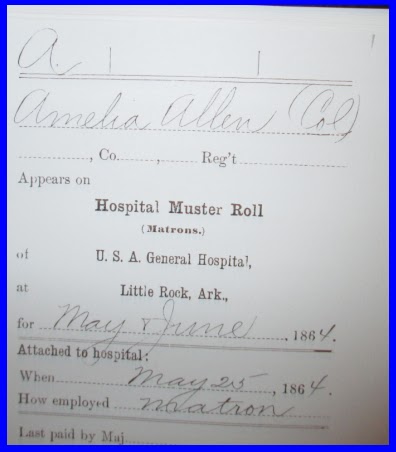
This service card reflects the Hospital Muster Roll 
USA General Hospital, Little Rock Arkansas of Amelia Allen who Served in the 
Union Army Hospital, Little Rock Arkansas, during the Civil War
Source: National Archives RG 94, Entry 535 Box 1

Last July I wrote an article about a ledger that I had located reflecting the service of "Colored Contract Nurses" who served in the American Civil War. In that ledger most of the nurses served in hospitals from Maryland to North Carolina. However I became quite interested in the additional places were women of color worked for the Union Army as Nurses, Matrons, and as laborers including laundresses and cooks.

I later stumbled  upon another set of records by accident. I was looking for a soldier who served in an Arkansas regiment, from the 57th US Colored Infantry. As this is one of my favorite regiments, I was interested in learning how many men in the entire regiment had filed for pensions and received them. I was leisurely scrolling through the regimental pension index when an unusual pension card caught my eye.

As expected there was the name of the soldier, his application number and his certificate number indicating that he had received a pension. It also was noted that his widow later applied for and received a widow's pension. This is common and appears on many cards where the pensioner was survived by a widow. But it was the note at the bottom of the card that struck me as a real find!


This pension index card made a reference to a US Colored Soldier's widow 
who applied for her own pension earned for having served as a nurse.
(Regimental Pension Index, 57th US Colored Infantry, 
Benjamin Moore, Co. B, 57th US Colored Infantry)


Upon seeing that information I had two tasks to complete that day. First I had to learn the name of his widow, as she was not named on the Pension Index Card. Secondly I had to ask whether names of other women who served as nurses could be found. I was successful on both counts!

The Pension file was thick--extremely thick and in the midst of the many pages (well over 150 pages) was a separate set of documents pertaining to Clara Moore. I had found her name, and tucked into his file was her own Pension File.  This is one reason the file was thick. The other reason was that there was a contesting widow who also claimed to be the widow of the same man! (But that is another story to tell at another time.) I was enthralled by having documented a woman of color who served as a nurse in the Civil War

Portion of document from Civil War Pension Claim of Clara Moore, Civil War Nurse

Clara's case was actually no without its complications. The surgeon under whom she worked as a nurse was deceased by the time she filed for her own pension, and there was difficulty in locating evidence of her having served, with the 57th as a nurse. Proving her case turned out to be difficult,  even though there was evidence in the file that she did serve and others made statements under oath of her service. Even very specific data was obtain pertaining to her enlistment and discharge dates were found. And I was please to find a detailed statement from Clara herself who also told part of her story.


I learned as I read through the file, that Clara and her husband later moved to Indiana after the Civil War, and then their marriage ended a few years later. However, both Clara and Benjamin remained in Indiana for the rest of their lives and for whatever reason, never returned to Arkansas.

Could others be found?
My second interest was learning whether more women of color who served in the war could be found and identified.  My task was to spend some time with the military specialist at the Archives, and see if more names could be located.

What a surprise to find that there is a series of service cards, pertaining to Civil War staff, including hospital employees. There are seven boxes in fact of service cards reflecting the service of civilian staff that served in Union hospitals.  I wasted little time, and requested to see these records.

The documents were identified as part of Record Group 94, Records of the Adjutant General's Office. The entry number is 535, and I decided on a recent trip to begin the process of documenting these women. I pulled the first box and began to sort through the many cards.

Label from Box 1 of RG 94, Entry 535.


Since there were so many cards, I decided to  begin a methodical approach to this effort and I began a process that will unfold over the next several months--to document all women of color who served as medical attendants in some capacity during the Civil War. Some had humble jobs as laundresses and cooks, but others worked alongside the doctors and surgeons as nurses and matrons.

So, beginning with the Box 1, and surnames beginning with the letter "A", my job has begun. In most cases women of color were flagged in some way with the letters "Col" or occasionally the word "Colored" spelled out. But their service records were there, and I was fascinated to also see the names of the hospitals where they served, as well. Some were familiar to me, but so many more were not.

Sample of Service Cards of "Colored" Matron 
who worked at Balfour USA General Hospital, in Portsmouth VA


Only looking at the cards, one can see that nurses of color were utilized throughout the nation were wounded needed care.In the cards below, the service of two different women are reflected. They are both called Anna, but one can see that one served in Mississippi and the other in Tennessee.

Service cards of two nurses. On served at the Freedman's Hospital in Memphis 
and the other served at a hospital for Freedmen in Davis Bend, Mississippi.

So my project begins. 

Over the next several months I shall access this collection of service records of Civil War nurses, and record the image of all women of color who served as nurses, matrons, laundresses and cooks.

Like other pertinent stories of the Civil War, these women, most of whom has just tasted the flavor of freedom, gave their all nursing those suffering from wounds, and from disease. 

May their stories also be told and may they never be forgotten!

* * * * *

Thursday, February 21, 2013

As March approaches, the 150th Anniversary of the organization of the US Colored Infantry took place. In honor of this regiment and it's amazing history, this video is shared. The video is part of a five year series provided by the Charles Wright Museum of African American History in Detroit Michigan.

Tuesday, January 1, 2013

A Sesquicentennial Year: Honoring The United States Colored Troops

Recruitment Poster for US Colored Soldiers

This is a milestone year for many reasons. The institution of slavery was beginning to become dismantled. On January 1st of 1863, President Lincoln issued the Emancipation Proclamation. Of course the proclamation was more symbolic than directly effective, however, it was significant nevertheless. But a true stake was driven into the heart of the institution  of slavery, in the spring of 1863, when a Bureau was established to organize regiments of "colored troops" to join the War. The companies formed were to be consolidated into batallions and regiments by the Adjutant General. Non commissioned officers were to be chosen from the men in the various companies.

The year 1863 was significant primarily because men of color were finally allowed to become officially involved in their own quest for Freedom. But they did not enter the war as runaways, they entered it directly as men willing to directly confront their enslavers, and to fight for the right to live as free men. And so it was,  in May of 1863 a mere four months after the Emancipation Proclamation was issued, General Order 143 was released. This order possibly had a greater impact on the lives of the enslaved than any other order during the War.

General Order 143: Creation of the Bureau of US Colored Troops
 War Department General Order 143: Creation of the U.S. Colored Troops (1863)
Source: General Order No. 143, May 22, 1863; Orders and Circulars, 1797-1910; Records of the Adjutant General's Office, 1780's-1917; Record Group 94; National Archives.

With so many commemorative events occurring between 2011 and 2015, it should be understood that one of the most critical years of the Civil War was 1863.

Finally black soldiers were allowed to enter the ensuing battle in their midst.  Although the goal was to preserve the Union for many and for others the battle was to secede and continue life as they knew it - including maintaining enslaving an entire people--for those who were allowed to enlist as Colored Troops, the issue was a simple one.  Theirs was a fight for freedom!

The effort to organize the various units was an enormous one, and by the end of the war there were more than 170 units, and these men comprised more than one tenth of the entire Union Army.

It should be pointed out that most of the enlisted men were "volunteers" enlisting to serve primarily in the War effort. These were designated as "US Colored" soldiers. However, in addition, there were some who were part of the regular army, such as the 5th Massachusetts Volunteer Cavalry, 54th and 55th Massachusetts Colored Infantries, and the 29th Connecticut Infantry.

It is also important to note that there were some units of men of color who had already organized, such as a group in North Carolina, the First North Carolina Colored Volunteers. Also a year earlier, in 1862, in Kansas  two regiments had organized and had seen action against the enemy. The First and Second Kansas Colored had already made a name for themselves a year before the US Colored Troops were organized.. Later these units re-designated brought under the jurisdiction of the Bureau of the United States Colored Troops as well. These men were all a part of a mighty effort of men of color who were true Freedom Fighters.

The enlistment of Black soldiers had a major impact on the families of the enslaved. Men were given freedom upon enlistment, and in many communities, the wives and children of those men who enlisted, often seized the opportunity and also freed themselves, forming communities near some of the Union encampments.These civilians were designated as "contrabands" of war, and many experienced freedom the first time due to the formation of regiments in their vicinity.

The participation of these Black men in the war was notable. They participated in major battles and campaigns from the Atlantic to the western theatre of the war. There were 17 Medal of Honor winners emerged from the US Colored Troops. However, the stories of all of the men who were truly men of courage must be told. The individual stories of the men are surfacing all the time, and finally these heroic freedom fighters are being honored. 


Hopefully as the anniversary of the organization of the various units unfold during 2013, the communities where they were formed will  honor these men! Because of what they did , true freedom came faster. Some paid the ultimate price for that freedom, and their courage should be honored during this sesquicentennial year.
Sgt. Major Christian Fleetwood, Medal of Honor Winner