Showing posts with label African American. Show all posts

Thursday, September 29, 2016

1st Sgt. Octavius McFarland - A Studious Man and Faithful Soldier

Photo Image: Collection of the Gettysburg National Military Park Museum
Civil War Service Record:  Carded Records Showing Military Service of Soldiers Who Fought in Volunteer Organizations
During the American Civil War, compiled 1890 - 1912, documenting the period 1861 - 1866
Source of Image: Fold3

The story of Octavius McFarland is a fascinating one that reflects the spirit desire that many men who joined the US Colored Troops had in making their lives better. McFarland was born in Lincoln Missouri, and enlisted with the Missouri 1st Missouri Colored Infantry. 62nd US Colored Infantry in the middle of the Civil War. He was quickly promoted to Sergeant after a month of service. Several months later, he was promoted to 1st Sergeant. The unit was also re-designated as the 62nd US Colored Infantry, so he and his regiment became part of the United States Colored Troops.

Among the unique field orders given to the men in the ranks was one General order No. 31. For those wishing to continue to wear chevrons upon their uniform, it was insisted that they become literate men and learn to read by January 1st of 1865.  If they failed, they would be reduced in rank, and replaced by men who could read and write. Those sergeants who were already literate were also required to teach other men, within their ranks to read.
“All non-Commissioned officers of this command who shall fail to learn to read by or before the 1st day of January 1865 will be reduced to the ranks and their places filled by persons who can read. In the position of Sergeants preference will be given to men who can both read & write and are otherwise good soldiers. All soldiers of this command who have by any means learned to read or write, will aid and assist to the extent of their ability their fellow soldiers to learn these invaluable arts, without which no man is properly fitted to perform the duties of a free citizen.” - Civil War News  August 2013

A majority of the men in this unit were men who had been kept illiterate as slaves from Missouri. Within the regiment, in January of 1865 it was announced that a competition was established to determine the "best writer" among the enlisted men. The decision, was with the intention of encouraging literacy among the enlisted men. Daniel Ullman was a commanding officer and in addition to supporting the effort of establishing literacy among the ranks, he also saw the need to reduce the level of corporal punishment towards the former slaves. Officers had been used to using their firsts and occasionally their swords for enforcement, and it was determined that another strategy was to be used in training men to become soldiers.

So, the competition announced early on in that year ended in July, two months after the war ended, but while the unit was still on active duty. On July 4, 1865 it was determined that Octavius McFarland was selected as the best sergeant in Company K, and was to receive a gold pen for his effort and determination. Their service continued, since they went on, in fact to the western frontier, and is said to have fought in the very last battle of the Civil War. The 62nd US Colored Infantry unit was claimed by General Daniel Ullman to be "the best under my command." And, by the time the unit mustered out in March 1866, almost every man in the regiment had learned to read and write, with Octavius being seen as the most outstanding and studious men.


Was McFarland Part of a Civil War Family?

In an effort to learn more about McFarland, it was decided to study the regiment more closely. Since the Civil War service records of Union soldiers are located on Fold3, it was decided to examine the records of the regiment in which Octavius McFarland served. He was with the 62nd US Colored Infantry. What was interesting to note was that there were six other men also enlisted in the same regiment with the surname McFarland. Of those, five of the six seemed to have come from the same community. In addition, the other four men are close in age, and all have a similar physical description.
Personal Description of Octavius McFarland:


From the service record McFarland is said to have been born in Lincoln, Missouri and was 21 years of age at the time of enlistment.

Four additional men also were described similarly:


Service records of additional Lincoln Missouri McFarland who may have been brothers.ivil War Service Record:  Carded Records Showing Military Service of Soldiers Who Fought in Volunteer Organizations 
During the American Civil War, compiled 1890 - 1912, documenting the period 1861 - 1866
Source of Image: Fold3

Albert, George, Henry and James McFarland were all born in Lincoln Missouri, and all enlisted (including Octavius) in the Union Army in December. All were farmers by occupation, all were described as "Mulatto" and they were all close in age. Albert was 24, George was 21, Henry was 23, James was 20, and Octavius was also 21.  Were they brothers? That is unknown. And even less known is what exactly happened to the men after the war. Octavius is found living in St. Louis working on a steamboat in 1880, but beyond that little is known. Did the other men survive the war? That also is unknown. 

It is said that Octavius McFarland died of tuberculosis in 1894, and was buried in Potters Field Cemetery in St. Louis. It is believed that he did not live with family, as the cemetery was for those with no next of kin. It this is case, then it is likely that he may have had no headstone, although as a soldier who served in the Civil War, he should have received a marker. The hope of this author is that those in Missouri who have an interest in preserving the history and legacy of men who have faithfully served the military, will work to see that this man will be given the honor that he deserves.

An interesting blog, called Faces of the Civil War depicted the life of Octavius McFarland and his efforts to become a literate man. Little else is known of him or the other 4 men from Lincoln Missouri. Hopefully an examination of regimental records and the record of one "Mother's" pension will reveal more to the story, and will be shared in a future article.

The regiment is also known for having been around during the establishment of Lincoln Institute in Missouri after the Civil War. Could the McFarland men been part of that community? Possibly, but again that is only speculation. Nevertheless, reading about this son of Missouri, has still been worthwhile, as so little is written about the men of color who served in the western theater of the Civil War.

****

Friday, April 4, 2014

On the trail of Yarmouth Cartwright


A recent article by Drusilla Pair, reflected the names of several black soldiers who were captured after the battle at Petersburg.  An article in the Richmond Dispatch listed the names of the soldiers simply as "captured Negroes" and although they were soldiers, the men were listed in the Richmond Dispatch only by first name. Since there was an actual reference to the fact that these men were "enlisted troops" the disrespectful posting of only their first names intentionally treated them as still enslaved men.

Like Ms. Pair, the article that she shared on her blog, Let Freedom Ring made me wonder about these men, and about their fate.

How were they treated? The policy of the confederate army was that they would "give no Negro any quarter" meant that they did not see these men of color as human enough to imprison, but simply as property to return or evil beings to kill. So the question rang again in my head, "how were they treated?"

Did any of these men survive being captured? It is widely known how many of the soldiers at Ft. Pillow were viciously killed and given no quarter, only three months earlier. So were the men on this list given food, and shelter?

The only way to find out was to see if any such men could be researched. So I examined the list that she shared.


There were many who had common names, so I knew that Johns, Henry's George's would not be easily traceable. But perhaps a man with a unique name could be found.  I saw a name of a man called Yarmouth, said to have been enslaved by a man called Alexander Kilga of Montgomery County MD.

The name of Yarmouth appears as the slave of Alexander Kilga


Since the name "Yarmouth" is unique, I decided to see if I could find such a soldier among the thousands of US Colored Troops.

I decided to use the Civil War Soldier and Sailors Database hosted by the National Park Service.

National Park Service Database

Two possibilities emerged: Yarmouth Carr of the 107th US Colored Infantry, and Yarmouth Cartwright of the 23rd US Colored Infantry.


I clicked on the first soldier to see if he was in a regiment that served in Virginia, which would be essential, since the men on the list were captured near Petersburg, Virginia. So I had to explore a brief history of both regiments and then to look at each soldier. I learned that the 107th USColored Infantry, was organized in Kentucky and in 1864 was ordered to Baltimore, and was in Petersburg from October 1864 till early December.


So this regiment would not have had soldiers in Petersburg around the time that "Yarmouth slave of Alexander Kilga", because that article was written in August of 1864, several weeks before the 107th was there.

The other regiment with a soldier called Yarmouth was the 23rd US Colored Infantry. This regiment was also in Petersburg and at the time of the big mine explosion.

So it was possible that the Yarmouth in this regiment was the Yarmouth on the list of "captured Negroes" listed in the Richmond Dispatch.

I decided to look at the Military Service records of the US Colored Troops and opened the images on Fold 3.

I had no idea which surname Yarmouth of the 23rd US Colored Infantry may have had, so I then made a very broad search for a soldier with only the name of Yarmouth.


Only one soldier appeared and his name was Yarmouth Cartwright.


So Yarmouth Cartwright served in Company A of the 23rd US Colored Infantry, By clicking on the image to go the service record I saw the following:


From this image I learned that this soldier Yarmouth was taken prisoner in early July of 1864.


From this image I learned that this was the man!! 

Yarmouth Cartwright was taken prisoner after being captured at Petersburg! So the man called Yarmouth, "slave of Alexander Kilga", was most likely Yarmouth Cartwright, a man who was a soldier, fighting for his own freedom!

I then wondered more about this man, did he survive being imprisoned? This was only a few weeks after the terrible massacre at Ft. Pillow, the battle in which Confederate soldiers vowed to give no Negro quarter. So, did this man survive the treatment as a prisoner, which was most likely not to have been kind for his very humanity was not even recognized by the enemy.

The answer was in the service record itself. The image above indicates that the soldier did return to duty! And the following image shows that he followed the regiment when they were sent to Texas and he was mustered out in Brazos Santiago, Texas in November.


After looking at the record on Fold3 and locating the service record of Yarmouth Cartwright, I was pleased to see that he lived through imprisonment and was not killed by those who were holding him prisoner. I had hoped that he would have lived to have enjoyed his hard earned freedom, and would have been able to marry and have a family.

A search on Ancestry provided the information that I sought. In 1870, he went had returned to Montgomery County Maryland, and was found living with a wife Mary, and three young children, Jesse, Joseph, and Samuel. He was free and was with his family.

Source Citation: Year: 1870; Census Place: District 4, Montgomery, Maryland; Roll: M593_591; Page: 475A; Image: 511; Family History Library Film: 552090.

Finding this man living free with wife and family was relieving. He was working as a farm laborer. I looked at others who lived nearby, and the closest neighbor did catch my attention. A woman of means lived close to the Cartwright family. The surname caught my attention. Margaret Kilgour. 


I then remembered that the article in the Richmond Dispatch referred to the soldier as Yarmouth slave of Alexander Kilga. The neighbor in 1870 was Margaret Kilgour. Could "Kilga", have possibly been "Kilgour", and was Margaret most likely the widow of Alexander, the said slave holder?

I wondered what the relationship might have been for this man, now a free man to have remained in the same area living close to the family that had once enslaved him. However, I have seen this occur in other states and in other families that I have researched. Many families returned to the community they knew as home, for they have lived in the area for decades and regardless of who the neighbors were, it was home.

I looked at 1880, and found the family still in Montgomery County, but without Yarmouth. An older Cartwright man was living with Mary and her children, and some additional children were now in the household. And interestingly, they still lived next door to Margaret Kilgour.


In 1890, Mary was found on the 1890 Surviving Widow's Census, in Montgomery County, Maryland.


Source Citation: Year: 1890; Census Place: Potomac, Montgomery, Maryland
Roll: 10; Page: 1; Enumeration District: 139.

My goal was to find the "captured negro" and to find him as a man.

I found Yarmouth the soldier, Yarmouth the man and Yarmouth the free man who survived the war and who lived to taste freedom. His story is a short one with few details, but we was so much more than a slave. He freed himself, enlisted to fight, served honorably and won his freedom. He returned home to live in the small farming community in Montgomery County Maryland. He married, had a family, and the Cartwright family continued to thrive, into the 20th century. I am happy and humbled that I can say his name. Yarmouth Cartwright, survived! May he not be forgotten.

Saturday, November 26, 2011

Spirit of Freedom and Other Monuments to US Colored Troops


This video tells the story of the Spirit of Freedom - the National Monument Honoring Black Civil War Soldiers

I attended the dedication of that monument in the summer of 1998 and was honored to witness the outpour of support from descendants of those 209,000 men whose names are inscribed on that monument as well. 

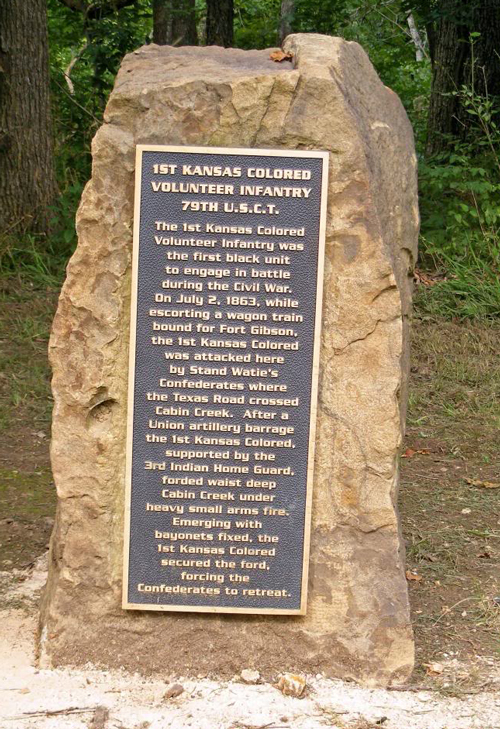
The following summer, I got to see another monument honoring black Civil War soldiers. I was attending a Civil War re-enactment of the Honey Springs Battle in Rentiesville Oklahoma and was delighted to see that among the monuments erected honoring the soldiers in that battle--the 1st Kansas Colored were depicted among those who fought nobly in that battle.


Of course, I have often pointed out that many who research the history of the US Colored Troops will frequently encounter other African Americans who have no knowledge of the ties that their own families have to the thousands of Black soldiers who fought and died for their freedom. In a recent discussion about this, it was mentioned again, that this occurs possibly because there are so few images or monuments devoted to the contribution made by more than 200,000 African Americans who served in the War.

Ironically in most southern towns somewhere in or near the town square is a monument devoted to confederate dead, and ironically there are so few monuments to the Black men who lived in the same communities who fought for their freedom.

Although there are less than two dozen, the list slowly growing. I did find a site devoted to Black Civil War monuments, and have written to have the inclusion of the Honey Springs battlefield monument to the 1st Kansas Colored (that later became the 79th US Colored Infantry), however, the change has yet to be made to reflect that monument.

Yet, the site deserves to be visited, again, because so few of us are aware of these soldiers and of their history. I am including a list of the monuments that are mentioned on the Jubilo site, with a link to the sites that contain more information about the monuments honoring these soldiers.


Connecticut 29th  Colored Regiment - Fair Haven Connecticut


North Carolina Colored Union Soldiers - Hertford North Carolina

USCT National Cemetery Monument - Nashville Tennessee

West Point Monument - Norfolk Virginia

As happy as I am to see these monuments---there are so many more untold stories. Perhaps when and if they are constructed, in the future we may see monuments honoring the fallen men as well, for their price was the ultimate price for freedom. Their bravery is still unsung.

Let us not forget to 

And as I have an ancestors who was ambushed in battle, I hope someday in central Arkansas that some will also Remember Jenkin's Ferry.

All brave men deserve to be so honored and remembered.

Sunday, January 2, 2011

The 3rd US Colored Cavalry Engage in Mississippi Skirmish Jan 2, 1865

An enlistment card from the Compiled Service Record
Aleck Atley, 3rd US Colored Cavalry
Source:  National Archives microfilm publication M1817. 
Compiled military service records of volunteer Union soldiers


*****************************************************************

*****************************************************************

In late 1864 into early 1865 Franklin Mississippi was at the center of a confrontation near Franklin Creek Mississippi. One of the units involved was the 3rd U.S. Colored Cavalry. This unit was originally organized from the 3rd Mississippi Cavalry of African Descent, and was later re-designated as the 3rd U. S. Colored Cavalry. They were mustered into service in March of 1864, and would serve in until mustered out  in January of 1866.  (Source: Dyer's Compendium of the War of the Rebellion)

A description of the battle and the events involving the 3rd Cavalry US Colored troops were recorded by Col. Embury Osband, commanding officer of the 3rd Cavalry Brigade.  They are recorded in the official records and are presented here.

        
The description of the military movements was extensive and I am only including the parts involving the 3rd US Colored Cavalry. Full description of the report by Col Embury Osmand can be found here.


 He then described how the men of the 3rd Cavalry engaged the enemy forces:

Now dismounted, the men of the 3rd Cavalry along with other Union soldiers of the 11th Illinois Cavalry, a white regiment joined forces. According to his report, members of the 3rd, US Colored, were able to repulse the enemy coming from another side.                     
                                
        
 The battle, though not a major one in the context of the entire war, was significant and fortunately the injuries and loss of life were not large in this particular incident.

 Source of data used for this report came from: The war of the rebellion: a compilation of the official records of the Union and Confederate armies. ; Series 1 - Volume 45 (Part I). The book is also digitized and can be found here.

Saturday, January 1, 2011

The USCT Chronicle --150 Years Later Getting the Story Right!


******************************************************************
    *******************************************************************

This is 2011, and the year that marks the 150th Anniversary of the Beginning of the Civil War.

It would be two years before the establishment of the United States Colored Troops, however, by researching my own ancestors I found incredible stories that centered around the Civil War, so the war in its entirety--from its beginning in 1861 is important. In addition, it is time to tell the story, and to quote a genealogist whom I respect---to get the story right!  Well, part of getting that story right----is this fact, the Civil War took place, because the freedom of a race was at stake. 

From the perspective of those who were enslaved----there was no other issue except freedom.  Some speak about the war being over a concept of "state's rights."  The enslaved had NO rights--so state's rights had no meaning to them.  But freedom meant everything!!! And for my ancestors that was the purpose and it was the result. To state otherwise is to malign the intelligence of a people, the integrity of an oppressed people, and to deny that they possessed the simplest aspect of their to live freely and with dignity.

When the war ended---my ancestors became free.  My own ancestors had a role, in that war as soldiers, as civilians and those who remained enslaved during the war years, they were affected by the war, and their freedom resulted from that war.

Most importantly-----there are STORIES that came from that war!  That is why I have created this blog --as  a platform to tell those stories.

In the past 20 years, I have documented 9 ancestors who served in the Union Army with the United States Colored Troops. I have identified others who were simply survivors of the war, of the era, and of the times.

Among some of those stories:

I learned and wrote about the story of my gr. gr. uncle, Sephus Bass of Giles County Tennessee, a soldier who enlisted in the 111th US Colored Infantry, and who survived, slavery, mustered into the Union Army, was captured by Nathan Bedford Forrest. More remarkably he and his brother and his two sons  escaped and later rejoined his regiment when they re-organized in Nashville.

I learned the story of my ancestor Lydia, a woman in Crawford County, Arkansas, who married John Talkington, who had joined the 2nd Kansas Colored Infantry, that was later re-designated as the 83rd US Colored Infantry.  John would die in the battle of Jenkins Ferry, but Lydia lived to tell her story, of life as a slave, her marriage to John, and I was fortunate to read her words and others who spoke in detail about her life before and after Freedom.

Lydia Talkington

I learned of another ancestor Amanda Young, of Ripley Mississippi, whose husband and son joined the US Colored troops, and whose father was one of the civilians that followed the troops when the Union soldiers raided Tippah County. I thank God for that raid!!!!

Following the Union Army when the raid came through the area, meant freedom at last! Though my Amanda lost all of the 3 men in her life that were so dear, I also learned how she found her sister, after 50 years of separation---a sister who spoke about life in the Contraband Camp at President's Island, when the fleeing slaves left Tippah in search for Freedom. I was amazed to see how this woman had the courage to remarry and find family life again. From that research, I found new cousins in the Barrs, and Reeds.

Ironically, if you go to a search engine like Google, and search for Tippah County, Civil War---the only thing you find is info on soldiers in the confederate army. Amanda's family is not reflected (yet!). Nothings exists to tell the stories of the hundreds of black soldiers who enlisted in the Union Army from the same area!  These are stories of men who had previously been enslaved and who seized their own freedom the moment the chance came. Thankfully, I have found some of them, and have learned some of their stories, and one of my goals is to tell some of the missing stories of the Black Union Soldiers from Tippah County Mississippi, from Giles County Tennessee, from the states west of the Mississippi, Arkansas, Kansas, and Indian Territory.

I also want to tell the stories of those refugee slaves who had the courage to flee from the people who held them once in bondage, to the contraband camps to breathe free air!  These were people who lived in different states and counties and who were enslaved with different circumstances affecting their lives.

They all had heartbreaking losses that slavery brought to millions of people--but they also survived, against the odds.  I want to tell some of those stories

So-----this blog begins!!!!  Join me on this journey to document those untold stories and to get the story right!!!