Showing posts with label Contrabands. Show all posts

Wednesday, January 11, 2012

General Burnside and Young Tom, a Contraband

Masthead for Frederick Douglass' Monthly, August 1862
Source: Accessible Archives, African American Collection

150 years ago in the month of February, a young man paddled his way to freedom in a canoe. It was said that "in that contraband's  hand, a victory was brought to the United States of America, led by Burnside."

I found this story of this young man, while looking at an issue of the Douglass' Monthly through Accessible Archives. What I discovered was the story of a  young many who rowed to freedom, who was befriended by General Burnside and who shared everything he knew about the countryside, allowing the General and his staff to map the area around Newbern , and to plan a military strategy that would lead to a major victory.


There were two things that stood out for me----first, the actions of the enslaved population are indirectly revealed--the enslaved people were fleeing to the Union lines and seizing their freedom. Secondly, this one young boy had a sharp memory--enough to allow General Burnside to map the area accurately and plan a military attack.
General Ambrose Burside
Source: Major General Ambrose Burnside, and the Ninth Army Corps
Providence: Sidney S. Rider and Brother, 1867
Online Edition of book available through Google Books

How wonderful that I was able to see such an interesting article in the Douglass Monthly. Although his name was not mentioned, I truly wanted to find out more about this courageous lad, and if his story was recorded any other place.

So after a careful Google Search, I came across an interesting work, called, Major General Amborse Burnside and the Ninth Army Corp, published in 1867. In that book, I found a full description of the same incident reported in Frederick Douglass' publication about the young boy, Tom. 

General Burnside was stationed near Hatteras, and calculating how to capture Roanoke Island. It is noted that a solution to his question rowed literally into his presence.

Source: Major General Ambrose Burnside, and the Ninth Army Corps
Providence: Sidney S. Rider and Brother, 1867, p 33
Online Edition of book available through Google Books


Tom proved to be a valuable aid to the officers assisting Burnside. He was able to describe the land, the location of troops on both sides and was able to assist the team of officers on the best place to land ashore.
 He was therefore treated well for his assistance, and was allowed to remain among the soldiers at Hatteras.

Source: Major General Ambrose Burnside, and the Ninth Army Corps
Providence: Sidney S. Rider and Brother, 1867, p. 33
Online Edition of book available through Google Books

Sure enough when the regiment sailed into the harbor to begin to take Roanoke, Tom led them to the spot where they disembarked and the plans unfolded.

Source: Major General Ambrose Burnside, and the Ninth Army Corps
Providence: Sidney S. Rider and Brother, 1867 p. 39
Online Edition of book available through Google Books


Another book mentioned young Tom and his impact on Burnside's operation. That book is called The Outer Banks of No. Carolina  1584-1958, by author David Stick. He refers to young Tom and the topographical engineer as the two heroes that helped to capture Roanoke Island.

What happened to Tom after the war? 

Did he survive the war, and live to see freedom?

Did he eventually move into the Freedman's Colony at Roanoke? No complete roster of the colony exists. But considering his relationship with the General and his staff, my hope is that he did survive the war, and begin life again and live to breathe free air in a time of peace. 

Young Thomas Robinson, like hundreds of other contrabands is one of may unsung heroes of the Civil War. His desire for freedom was fulfilled and he shared his skill and knowledge of the land with General Ambrose Burnside and his actions had direct impact on a major campaign in America's Civil War. The small article published by Frederick Douglass in 1862, provided a small glimpse into how even the most ordinary actions of one person can bring about change.

The sesquicentennial anniversary of young Tom's arrival at Hatteras will take place in February and I for one shall remember him as those days approach.

Union Army Overtaking Roanoke Island


Sunday, June 19, 2011

Lessons Learned from Contrabands at Camp Nelson


* * * * *    * * * * *    * * * * *

I just had the experience of attending the week long Institute for Genealogical and Historical Research in Birmingham Alabama, on the beautiful Samford University Campus.  I participated in Course 8: Land Records: Using Maps.

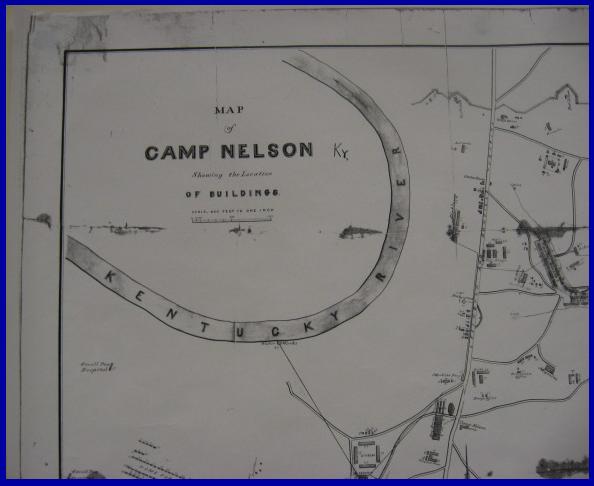
We discussed many things including military maps. Examples of all kinds of military maps were shown, but one map caught my eye immediately.  It was a map of Camp Nelson, in Kentucky.

Map of Camp Nelson

The camp had been surveyed and platted by A.B. Miller, one of a small number of engineers approved by the government to survey military lands.

Map was platted and surveyed by A.B. Miller

The map is part of the National Archives Record Group 92 and the image is map number 74


But what caught my attention is that the map also reflected the presence on the military base of a community of refugee slaves.  This was, in fact, a contraband camp.

Map reflected "home for colored refugees"

I studied the map and became interested in the size.  The scale indicated that 1 inch was equal to 400 feet. By measuring the length of the refugee site, I was able to learn that the camp for former slaves was more than 1000 feet in length. It appeared that by the time the map was made, the camp no longer consisted of tents, but of separate dwelling for each family. 

Of course having a strong interest in contraband camps I decided to learn more about the Camp itself. Could I possibly learn something about the lives of the refugee slaves? 

Well I played with the name of Camp Nelson, and discovered a book, by Richard D. Sears.  His book is called  simply "Camp Nelson, Kentucky".  

Book by Richard Sears 

The book is a true gem for it also described how freedom was brought to many of the refugees and how they learned officially of their status:


(Image of text from Sear's book)

In March of 1865, several hundred refugees had occupied the camp and it was decided to move from the temporary tents to the use of wooden structures to serve as temporary homes for the refugees. Order was being established and the word was sent out by the superintendent of the camp that teachers were needed, as well.

Excert of letter from Sears book.  Letter appears on page 185 of book.


Some of the stories about the former slaves appear in the book, taken from official records.  On page 186 he tells the story of Martha Cooley, a slave of John Nave of Garrad County Kentucky.


(Excerpts taken from book by Richard D. Sears)

There were so many stories of the trials and agonies of the slaves who described the beatings and horrors of Kentucky slave holders who tried to prevent their slaves from escaping. Many stories described horrific beatings given to female slaves whose husbands had enlisted in the Union Army. But nevertheless, some did make it though and although conditions were harsh also at the contraband camp, with disease, Camp Nelson was still their portal to another life.

As I continued to read more, I was even more delighted to discover online, an actual image of the Camp Nelson Contraband Camp.


One of the points made in the week long course on maps at Samford, is that many maps tell stories.  This proved to be true, and it took me to an experience where I learned more about the lives of those slaves who escaped.  

I have such joy to learn of those who made it to freedom. And my heart aches for those who stayed behind and could not leave. Their fate was a painful one at the hands of angry masters in so many cases.

I never would have thought that a week long seminar on maps would provide another opportunity to learn more about some dimension of the lives of the ancestors.  

And on this day when we celebrate freedom, I  salute the Ancestors and thank them for their strength and endurance. 

It is upon their shoulders that I stand. And so, I shall continue to trace the footsteps of the Ancestors.

Thursday, January 20, 2011

A Small Taste of Freedom

Service Record of Pvt. Alfred Dandridge, 2nd US Colored Lt Artillery


It is understood how service in the Union Army during the American Civil War brought about a change in the lives of many who were once enslaved.  For them, the chains of slavery would be broken, and for the first time they would be seen and treated as men. For many, like the man whose name appears above, the experience would be brief, for they had entered a mighty war, and so many lost their lives paying the ultimate price for the right of freedom.  The only comforting thought is that these men tasted a small bit of freedom, and breathed free air, only briefly before they died.

But we have to look at all of the pieces of data to tell some of their stories, even when their stories appear to be brief, and without detail. Their stories are long gone, and most descendants have no idea that their ancestors had fought for their freedom.  

Can their stories be found? 
And can some elements of a story be extracted from the many factual records left behind?

Before enlistment for those who had been enslaved, the only time the soldier's name appeared in print was in an estate record or tax record, naming them as property. So the service records of the US Colored Troops, are more than mere pieces of data of unknown men.  They  provide clues to some aspects of the lives of those who were not only soldiers for the first time--- but they were also novices to freedom and how sweet the air they breathed breathed must have been.

In the case of Alfred Dandridge, he was a  young man of 19, and for a man who had probably been a laborer since childhood, he could be considered in the middle of his life.  Beyond the years of being a toddler, he would have carried water, to the field slaves, and been a carrier of items for adults until his body was old enough to perform labor.  

But there is another strong detail about Dandridge's life that is worth noting.  He was mustered in at Ft. Monroe.  Significant? Oh yes!!!  Virginia was the heart of the Confederacy and most of Virginia was Confederate, but Ft. Monroe remained in Union hands. 

This is significant, because for many of the enslaved in Virginia---Ft. Monroe was a destination and it provided sanctuary for those fleeing to freedom. Refugee slaves had been declared "contrabands" of war, and if they could simply make it to the fort---they would find freedom.

The taking in of slaves as contraband, provided much needed manpower for the Union Army as well, when the Bureau of the US Colored Troops was established.  

This political cartoon reflects the taking in of slaves as "contrabands."


Those slaves arriving at places like Ft. Monroe, were put to work, and many of the men enlisted in the Union Army to fight.
Stampede of Slaves to Ft. Monroe, shown in Harper's Weekly, 1861

Looking more closely at Alfred Dandridge's service record, one can see something important:

Alfred Dandridge mustered in, at Ft. Monroe

Dandridge enlisted at Ft. Monroe, and there is a very strong possibility that he had been among the man contrabands of war.  He made it to Ft. Monroe!

The significance of this man's simple life, is that we know his name.  Even contrabands, is used as a term describing countless slaves, seeking freedom, and so few of their stories are actually known, and even less are their names!

We can construct a few details about his life. This young man, a laborer from the fields of York County, made  it to Ft. Monroe and enlisted in the 2nd US Colored Lt. Artillery in January 1864. He remained at Ft. Monroe, until the unit was moved in April of that year where the men in his unit joined Gen. Butler's campaign against Petersburg and Richmond.  His unit saw action at Wilson's Wharf, as well as at  Petersburg.  They remained in that are until July 7, when they were ordered to Portsmouth. The soldiers remained at Portsmouth until spring of 1865, after the surrender when they were sent to Brownsville Texas in May 1865.  They served along the Rio Grande during that time.  In the fall of 1865, Pvt. Dandridge became ill and suffered dysentery.  He did not recover from his illness and on November 2, 1865,  he expired. His unit remained in Texas until May 1866.  Pvt. Dandridge found freedom, served honorably as a soldier, fought in battles for that freedom and died a free man!

Alfred Dandridge died Nov. 2, 1865

But----we know his name, and he did not die in vain!  And I am thankful for the small taste of freedom that he was able to have. To him and countless others, who served and died, I am grateful.  Continue your well earned rest, Alfred Dandridge!  You were an honorable man.


Saturday, January 1, 2011

The USCT Chronicle --150 Years Later Getting the Story Right!


******************************************************************
    *******************************************************************

This is 2011, and the year that marks the 150th Anniversary of the Beginning of the Civil War.

It would be two years before the establishment of the United States Colored Troops, however, by researching my own ancestors I found incredible stories that centered around the Civil War, so the war in its entirety--from its beginning in 1861 is important. In addition, it is time to tell the story, and to quote a genealogist whom I respect---to get the story right!  Well, part of getting that story right----is this fact, the Civil War took place, because the freedom of a race was at stake. 

From the perspective of those who were enslaved----there was no other issue except freedom.  Some speak about the war being over a concept of "state's rights."  The enslaved had NO rights--so state's rights had no meaning to them.  But freedom meant everything!!! And for my ancestors that was the purpose and it was the result. To state otherwise is to malign the intelligence of a people, the integrity of an oppressed people, and to deny that they possessed the simplest aspect of their to live freely and with dignity.

When the war ended---my ancestors became free.  My own ancestors had a role, in that war as soldiers, as civilians and those who remained enslaved during the war years, they were affected by the war, and their freedom resulted from that war.

Most importantly-----there are STORIES that came from that war!  That is why I have created this blog --as  a platform to tell those stories.

In the past 20 years, I have documented 9 ancestors who served in the Union Army with the United States Colored Troops. I have identified others who were simply survivors of the war, of the era, and of the times.

Among some of those stories:

I learned and wrote about the story of my gr. gr. uncle, Sephus Bass of Giles County Tennessee, a soldier who enlisted in the 111th US Colored Infantry, and who survived, slavery, mustered into the Union Army, was captured by Nathan Bedford Forrest. More remarkably he and his brother and his two sons  escaped and later rejoined his regiment when they re-organized in Nashville.

I learned the story of my ancestor Lydia, a woman in Crawford County, Arkansas, who married John Talkington, who had joined the 2nd Kansas Colored Infantry, that was later re-designated as the 83rd US Colored Infantry.  John would die in the battle of Jenkins Ferry, but Lydia lived to tell her story, of life as a slave, her marriage to John, and I was fortunate to read her words and others who spoke in detail about her life before and after Freedom.

Lydia Talkington

I learned of another ancestor Amanda Young, of Ripley Mississippi, whose husband and son joined the US Colored troops, and whose father was one of the civilians that followed the troops when the Union soldiers raided Tippah County. I thank God for that raid!!!!

Following the Union Army when the raid came through the area, meant freedom at last! Though my Amanda lost all of the 3 men in her life that were so dear, I also learned how she found her sister, after 50 years of separation---a sister who spoke about life in the Contraband Camp at President's Island, when the fleeing slaves left Tippah in search for Freedom. I was amazed to see how this woman had the courage to remarry and find family life again. From that research, I found new cousins in the Barrs, and Reeds.

Ironically, if you go to a search engine like Google, and search for Tippah County, Civil War---the only thing you find is info on soldiers in the confederate army. Amanda's family is not reflected (yet!). Nothings exists to tell the stories of the hundreds of black soldiers who enlisted in the Union Army from the same area!  These are stories of men who had previously been enslaved and who seized their own freedom the moment the chance came. Thankfully, I have found some of them, and have learned some of their stories, and one of my goals is to tell some of the missing stories of the Black Union Soldiers from Tippah County Mississippi, from Giles County Tennessee, from the states west of the Mississippi, Arkansas, Kansas, and Indian Territory.

I also want to tell the stories of those refugee slaves who had the courage to flee from the people who held them once in bondage, to the contraband camps to breathe free air!  These were people who lived in different states and counties and who were enslaved with different circumstances affecting their lives.

They all had heartbreaking losses that slavery brought to millions of people--but they also survived, against the odds.  I want to tell some of those stories

So-----this blog begins!!!!  Join me on this journey to document those untold stories and to get the story right!!!