Showing posts with label Arkansas USCT. Show all posts

Sunday, July 19, 2015

Rare Photo of Arkansas Black Soldier Located in Civil War Pension File

Image of Aaron Brooks, Corporal, 54th US Colored Infantry


A research trip to the National Archives has uncovered the image of a long forgotten freedom fighter. Aaron Brooks was a soldier in the 54 Arkansas Regiment of United States Colored Troops.

The photo had been mentioned to me, when I spoke in Arkansas in April of this year. A woman who is conducting graduate studies mentioned that she had seen an image in the file. I finally got the opportunity to conduct some research and to request the Civil War pension file of the soldier. The file itself was thin, with not many details about the soldier, nor much about his widow who received a pension after his death.

The image was a small one, that had been affixed to a small piece of paper, and if not looking closely could have been overlooked. And the image, even while affixed to the piece of colored paper, was still small enough to hold between two fingers of my hand.


The photo had been placed, thankfully in some protective transparent paper, to protect it.


Looking at the photo in the small file brought thoughts to mind. Most likely this photo was submitted by the widow, to whom it was clearly never returned. At the same time, the importance of this photo is enormous--this is the first image to my knowledge that has ever been noted of an Arkansas USCT whose name is identified. And, this is possibly, the first Civil War image of an Arkansas Black soldier taken during the time in which he served.

I examined the image closely to note as many details as possible. It was important to zoom in on his face. This face of this young man is the first face that can be named, of an Arkansas Black Union Soldier. Of the many USCTS buried in Ft. Smith National Cemetery, and the USCTs buried Little Rock National Cemetery, this image of Aaron Brooks finally adds a face to the Arkansas Black freedom fighters. 

Corporal Aaron Brooks, 54th US Colored Infantry

Aaron Brooks, the Soldier:

Born in Phillips County Arkansas, he enlisted in the Union Army in Helena, in June 1863. Within a few short months, he was promoted to corporal. The promotion was recorded in April 1864. After that promotion was when the photo above was made as his corporal stripes are reflected on the sleeves of his uniform.


Corporal strips visible on soldier's sleeves

Aaron Brooks was possibly as literate man, as a signature bearing the name of the soldier was found at the bottom of the image. If he was a literate man, that may be one of the reasons he was promoted after several months of service.

Bottom of photo showing hand written name, "Aaron Brooks"

It should be noted that this standing photo of Aaron Brooks is one of the first, if not the only image known to identify a Black soldier from Arkansas taken during the Civil War. Seeing this image of Corporal Brooks standing with his musket on the side, and white gloved hands to his side reveal a sense of dignity that this man, once enslaved, could at last display.

 The service record of the soldier indicates that he was a young man of 22 years.


Aaron Brooks, the Man

After the war he remained in Arkansas and lived as a farmer. He married in the late 1870s and together they farmed in the community of "Young township" in Pulaski County. Young Township no longer exists in Pulaski County. He was enumerated with his wife Dicey in the 1880 census.


1880 Federal Census, Young Township, Pulaski County Arkansas


In 1890 Aaron Brooks filed for an Invalid pension, but shortly afterwards, died, before collecting a payment. His widow Dicey also applied for a pension but it appears that although she did not pass away until 1914, she only received one payment.


Civil War Pension Payment Card
Family Search Image

In spite of the lack of detail about Aaron Brooks, the photo says it all. A man once enslaved was given an opportunity to fight for his freedom. He seized this opportunity and served honorably. He was a loyal soldier, whose name we now know, and whose name we should not forget. Like thousands of others from his native Arkansas soil, he represents them. He sought no accolades, or honors after his service. He lived a quiet life, worked the soil as a farmer, and died. But he shall not be forgotten, for we now have the image of this man, erect, proud and standing with dignity.

How fitting that in the 150th years since the Civil War ended and freedom was obtained for 4 million others once enslaved, we now have the image of this son of Arkansas, to be counted among the 200,000 men of color who served their nation. He was a simple man, but now we can look at his young face and say, thank you, Corporal Brooks. Your people appreciate what you did.


Saturday, January 25, 2014

A Sesquicentennial Year: Battles Involving US Colored Troops in Arkansas 1864

Soldiers of the 57th US Colored Infantry at a Reunion after the War.

In 1864 a large number of regiments were organized throughout the country, including Arkansas. Six regiments were organized within Arkansas, but other regiments organized in other states would find themselves fighting for freedom within the state.

This year, marks the 150th anniversary of many of the battles and skirmishes in which Arkansas black soldiers fought, and in honor of their efforts they are listed here.


There were 11 different regiments that fought in battles on Arkansas soil during the year 1864. Two of the regiments were originally organized as the 1st and 2nd Kansas Colored Infantries. They would be among the first Black Union soldiers to engage the enemy in battle as early as 1862. In late 1863 they were re-designated as the 79th and 83rd US Colored Infantries. The Kansas Colored fought in Island Mound Illionois a year before the US Colored Troops were established.  

Several of the Arkansas battles that involved Black soldiers were truly noteworthy such as Poison Springs, in which many wounded black men were massacred by Confederate soldiers after they lay wounded on the ground. As the Confederate Army was committed to giving "no Negro any quarters" and after the vicious massacre of the injured men occurred, Poison Springs would later become the battle cry of Arkansas black soldiers. 

It should be noted that within one week's time---two major massacres of Black soldiers occurred in the Civil War. The infamous Ft. Pillow massacre occurred in Tennessee on April 12th of 1864. In that case after being outnumbered and surrendering---confederate soldiers chose not to see the humanity of the black soldiers and brutally killed hundreds who had surrendered. Historian Richard Fuchs described the outrage at Ft. Pillow, “The affair at Fort Pillow was simply an orgy of death, a mass lynching to satisfy the basest of conduct – intentional murder – for the vilest of reasons – racism and personal enmity." (1)

A mere six days later in Arkansas--the same thing occurred. This time, many of the men were already injured and lying on the ground. And they to were cruelly and maliciously massacred by the confederate army devoted to never recognizing their humanity. It was also reported that many of the Black Union soldiers were murdered even after the major fighting was over. The outrage at Poison Springs, indeed became a logical battle cry from that time onward for those once enslaved, "Remember Poison Springs!"

So, in this sesquicentennial year, the seriousness of purpose of the US Colored Troops is noted and those who fought and who died upon Arkansas soil are honored. May their efforts be always remembered and may the courage and the stories of these men once enslaved, and now daring to face the enemy, be told.

* * * * * *
(1) Richard Fuchs, An Unerring Fire: The Massacre At Fort Pillow (Mechanicsburg, PA: Stackpole, 2002), 14.


Wednesday, December 14, 2011

Will We Come When They Tell Our Story?


There has been much discussion in recent days about the lack of interest in Civil War from the African American community. 

To me, the lack of interest is merely a symptom of a larger problem. Much of it stems from a lack of knowledge, and from minimal efforts to teach, grow and learn from a rich history. But when that rich history is ignored and not taught by the very community itself, the end result can only be a misunderstanding of one's own past and this leads to blatantly low self esteem.   

The Civil War---for many people of color is a story about places. There were the major battles in places like Gettysburg, Shiloh, Antietam, Bull Run. There were other incidents in places such as Pea Ridge,  Jenkins Ferry, Chapin's Farm, Petersburg. Yet these are place names that mean very little to the average person of color. There are fleeting images that might come to mind (if at all)  when these battles are celebrated or commemorated with flags, ammunition and fanfare.

In today's life, few African American children experience vacation trips to visit battlegrounds such as Petersburg, and should they go there on a school field trip, do they see their own faces reflected?

When the local community honors a civil war incident, there are ladies in hooped skirts, men in uniform--blue and gray, lots of flags---usually more Confederate flags---and that---to most people of color is a sign---stay away and protect the children! There is usually some period music being played at these events by a small drum and fife corps, and frankly few black parents take their children to such events. But why?

The discussion about the Civil War frequently has two arenas---one in the classroom and the other in the general public.  The recent comments in the press---those questions are being asked by scholars---who don't speak to the public--in many cases they speak to their colleagues--other historians.  

The other arena is the public arena. And it is from the public arena where one finds many Civil war enthusiasts---re-enactors, living historians, local preservationists. But---most of those faces are not faces of color. At many public events where local celebration occur--there is a lot of fanfare. Guns, cannons, and flags. Especially the one flag that represents terror to many people. It brings back 20th century horror, and terror, and its very origins from the Civil War are enough to just say stay away and let folks have their 19th century party.  

But then in 1989, came the movie Glory, a film which told a story of some brave men from Massachusetts, who became soldiers. But a child from Arkansas, or Mississippi, or Louisiana, or Alabama, the film has no connection to those men. 

In Arkansas as Civil War celebrations emerge, from Pea Ridge to Jenkins Ferry, yet when the story of Jenkins Ferry is told, quite often but it is often told without mention of the Kansas Colored Infantry---later known as the 83 US Colored Infantry that fought at that battle. 


Do the children of Louisiana learn about the 39 regiments of US Colored Troops that were organized there? All children should know this--no other state in the union produced so many regiments!!


Historical Illustration of Black Soldiers at  the Battle of Port Hudson, Louisiana

How many children in Mississippi know about the amazing contributions of black Union soldiers in the Vicksbug Campaign? Several thousand black men were involved---but are the children both white and black, that live along the Delta taught this?

Historical Marker Denoting the Seige of Vicksburg


A Rare Battle Monument Honoring Black Soldiers at Vicksburg

The stories go on and on. But for the average person, and the effects of the war are still told from side only. 

There are countless stories told about Union armies raiding small southern towns. One reads about the effects upon the town--good folks who lost property. Yet---some of the property lost consisted of human property. And their ownership of human beings as property has yet to be addressed---and this is what keeps so many who descend from that human property so silent. There has been no mention of the wrongness of it all. But these things did happen and yes, slaves were part of the property of the good folks. Their enslavement was morally wrong and their freedom was never celebrated. It was hushed, not mentioned and buried.

And even less known are the stories of the contrabands the ones who seized their freedom. And truly, the heart of the story of liberation was the story of the thousands who made it to the Union lines---on foot, by wagon, horses, mules and in some cases later taken by train to settlement camps----because they had the courage to free themselves.

But the story told that prevails is a romantic story of Tara and Gone With the Wind. For most people of color, Gone With the Wind is a horrible story--and nothing more than a slave owner's love story. Even decades after World War II ended, Hollywood would never make a movie of a Nazi love story--yet America and so many Americans dream of life in the good ole days and often see themselves as Scarlett, and long for Rhett Butler and love that movie! The people who were victims of Scarlet and her social class are depicted as caricatures, merely presented for laughter. The pains suffered of the people enslaved by Scarlett, are not visible, not shown and their personalities are shallow at best. 

Until the larger story of human beings who resisted, are told, until the stories of those who eventually succeeded are told,  and until they are presented as people with a history worth telling, the lack of interest in this Civil War story will continue.

Library of Congress Image of Contrabands Arriving at Union Lines

How can this be taught well?  Has a curriculum been established to teach this portion of Civil War history? 
Not as yet. Therefore, as the sesquicentennial celebrations continue---and they will continue till 2015---the silence of many will continue.  This silence is rooted in the burying of the story of what happened to so many. 

My question is, will we come when they tell our story?

At least some are beginning to ask the right questions, and I have hope that things might change.

Saturday, April 30, 2011

Remembering Jenkins Ferry

When General Frederick Steele sent a large contingent of Union soldiers into the Camden Arkansas area, there were black soldiers among them from the 1st and 2nd Kansas Colored Infantries.  After a major military campaign, Steele led the Union forces into southwestern Arkansas. The plan was to join forces with another battalion of Union soldiers to secure northern Louisiana and then move to secure southwestern Arkansas before moving into Texas. 

However, the Union Army forces in northern Louisiana had suffered defeat at Confederate hands, now leaving General Steele's Union soldiers less secure than had been planned.  In addition, the Union forces were suddenly very low on supplies.

General Frederick Steele
Source:  Library of Congress, Civil War Photograph Collection, Photographs Division

Earlier in the month, Steel had occupied the area around Camden Arkansas, but his forces had lost many men at Poison Springs, and at an incident at Mark's Mill.  Steele had to turn his forces back towards Little Rock. After a heavy rain had fallen, Steele's troops were crossing the flooded waters of the Saline River, when suddenly they were attacked, and the battle had begun.

The confederate leader, Edmund Smith had launched the attack, and the battle began in knee deep waters. Although the Union forces were able to hold off the attack long enough to cross the swollen river, they were not able to secure the area, and had to retreat back northward towards Little Rock. The battle was fought with many injuries to both sides.

Illustration depicting the Battle of Jenkins Ferry

The ambulance corps from the 2nd Kansas Colored had been ordered to collect some of the wounded, when they too were ambushed. Many died and many were injured in the process. Steele eventually got most of his forces across the river and ordered his men to destroy the pontoon bridge. From the Union Army over 700 men were killed or reported missing, and it is said that close to 1000 men from the confederate army also died.  

It is said that at this battle of Jenkins Ferry, men from the Kansas Colored were motivated by their battle cry, "Remember Poison Springs" and that some engaged in revenge killing of the enemy retaliating for their comrades killed at Poison Springs. 

The south was successful in controlling the area, forcing a retreat of Union soldiers back towards Little Rock. However, the forces under the control on Gen. Steele were still intact including the men of the Kansas Colored, and they would meet the enemy again in Arkansas, and later Indian Territory later the same year. 

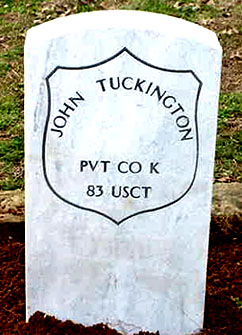
I share this story on this day, in honor of my ancestor John Talkington, who was injured at Jenkins Ferry.

Pvt John ( AKA Tuckington) Talkington
In Memory of John Tuckington (Talkington), my ancestor, wounded at Jenkins Ferry


Tuesday, March 1, 2011

Looking at Civil War, It's History and Why We Don't Know More

* * * * * * * * * * * * *
Image of 54th Massachusetts Seige at Ft. Wagner

Several weeks ago in a weekday genealogy online chat, the Civil War Sesquicentennial came up in the conversation.  The participation of the US Colored Troops was mentioned and the various regiments were brought up.  One regular member made a comment that surprised me. "I wonder", he said, "how were so many men able to escape to Massachusetts to join the Union Army."   

"What?"  I asked him to repeat his statement, or to clarify what he was asking.  He restated it, wondering how so many men who were slaves in the South, got to Massachusetts, during the war to join. I realized that this visitor, a regular to the chat and a long time family researcher, had no idea that the men who served in the US Colored Troops---were from the south, enlisted in the south, and fought in the south. They had to escape to get to the Union lines where the Federal soldiers were encamped, but why did he think they fled all the way to Massachusetts to enlist?  He then started talking about the movie "Glory" and the 54th Massachusetts, and then I realized it.  He had never studied the Civil War. Ever!  

But, I began to think about how and why a man in his 60s had no concept of the Civil War, and the involvement of black soldiers, and why he was under the impression that there was only one regiment of black soldiers---and all were in the 54th Massachusetts, depicted in Glory!  And I had a larger question----was he alone in this thinking? I thought about it----and sadly I realized that he was not alone and was not unique. The fact is---most African Americans have never studied the Civil War, nor relished many stories from the war----because the involvement of our own people in our own fight for freedom---is not widely known and has never been taught.   The movie Glory, even with the many historical errors in the film----is the only movie to ever tell the story of black soldiers in the American Civil War.  

So then I asked myself how many Civil War or Civil War era movies have been made in general?  

I made a query on Google, and I was surprised that there were quite a few. Some of them went back to the beginning of the movie industry:

An Occurrence at Owl Creek Bridge
Andersonville
Drums in the Deep South
Gettysburg
Gettysburg Three Days of Destiny
Glory
Gods and Generals
Gone With the Wind
How the West Was Won
Major Dundee
North and South
Outlaw Josey Wales
Red Badge of Courage
Ride With the Devil
Shadow Riders
Shenandoah
The Birth of a Nation
The Blue and the Gray
The General
The Good, the Bad and the Ugly
USS Hunley
Wicked Spring


As I look at the list, two of them stand out in my mind. The Birth of a Nation was a film that did so much harm in the depiction of former slaves as intrinsically evil and a film that glorified the KKKlan and made them  the "heroes" who saved the south. This film did so much harm to black families struggling in the South scraping a living as sharecroppers.  It depicted them and their families as people deserving of being relegated to the mistreatment and lynchings of the era and made them "deserving" of any harm directed to them.

And there was Gone With the Wind, a movie I refused to watch until I was in my 40s and hated it for it represented---a glorification of slave owners and slave life with happy and simple minded slaves like Prissy. I continue to be amazed at how many people find that film to be such a wonderful love story when a major part of this country find it nauseating. With the other films---African American soldiers don't exist and were not participants in the war.

There have been documentaries in recent years that have included the involvement of US Colored Troops.
• Ken Burns, The Civil War (1990 Mini-Series PBS & Turner Home Entertainment)
• Civil War Journal II 

After looking at that list and thinking about the man in the chat, I then began to think about another phenomenon. 

Anyone who grew up in the south---knows---that just about every town, or at least every county seat has some kind of monument to confederate soldiers. 

From an African American perspective, those monuments were simply one of the many indignities that life brought----monuments honoring slavery, the continuous us of that flag, the obstacles brought by segregation, and the hundreds of attacks upon innocent people usually with that flag being waved by angry mobs and so much more---it was just part of living in the south.  But we had learned to just ignore the indignities and go about life. 

At sporting events when the son Dixie was played we knew to just stay quiet while white people would cheer, get emotional and feel some kind of tie to a time that we were thanking our God that such time had passed.  It was just part of life---expect the insults, for that is what they were, we ignored them and went on with more important issues at hand, for one's daily life.

But in recent years---thankfully in the years since more have had access to better education, the involvement of African Americans and the participation in the Civil War is now openly discussed and this discussion has created a new initiative to tell the story. 

This has been enhanced by genealogical research that so many families have undertaken, and a new awareness has emerged because their own family was involved in the Civil War and they are documenting it!

Page from Pension File of Isaac Alexander, a soldier in the 79th US Colored Infantry

But then I reflected again on the conversation in the chat. The interest in US Colored Troops in the Civil War surged after 1989 when the movie Glory was released.  A few years later, in 1998, the African American Civil War Monument was also unveiled. 

African American Civil War Monument, Washington DC

Re-enactment groups have arisen over the years, many of which reflect the histories of specific regiments of US Colored Troops.  


Images above:  USCTs  (left)   Reenactor group from BennieMcCrae's website (right)

Of course this has been an uphill battle for just as quickly as USCT history has emerged, many fell victim to strong arm propaganda about mythical black confederate battalions that just did not exist.  Anecdotes of loyal slaves are always shown as some kind of "proof" that these groups existed, but finally historians are expressing themselves more loudly against the myth makers and the message is getting through to the audience that needs to hear the simple fact that there were over 178,000 black men who fought for their own freedom, joined the Union Army to do so, and 16 Medal of Honors were awarded from their ranks.  

I had to stop and think about that----16 Medals of Honor awarded, and most people cannot tell you the name of one man.  This is not taught at all. 

Headstone of William H. Barnes, one of 17 black Medal of Honor Winners in 
the Civil War

I think that I was able to learn why we don't know more and how even slight USCT history is not common knowledge.  I also realize that after the Civil War, when those who had seceded were given back their power and status and that of former slaves was legally made second class by Jim Crow, those black ex-soldiers were not able to freely celebrate their days of glory as victors in the war.  Most lived in the only place they knew as home, and their victory and their post war years of celebration, would have made them easily targeted as they lived among those against whom they had been fighting.

Schools did not include black civil war soldiers in the curriculum, and black schools subject to inspection at anytime by a hostile school board, would not have tolerated stories of Union victories and bravery of black soldiers during those vulnerable post civil war and early 20th century years. 

Also by being identified as Union soldiers in their local communities, they might have been targets for violence towards them and family, so they became silent heroes, or as a good friend and colleague has called them many times, "soldiers of silence."  

In my Bass family in the 1880s that family was a victim of "night riders" who killed my gr. gr. grandfather.  His son, my Uncle Sephus Bass, did get in some good shots and had to leave west for Texas where he did spend the rest of his life.  

1879 Painting Depicting Klan Attack. My Bass Family was attacked by Klan night riders and my gr. gr. grandfather Irving Bass (father to Sephus Bass) was killed. Irving had two sons (Sephas and Braxton) and two grandsons, Henry and Emmanuel who served in the 111th US Colored Infantry together.  

So many people to this day still do not know that they have ancestors who were Union Army veterans.  

The good part of the story is that the numbers are increasing.These silent warriors deserve to be honored and to have their stories told. 

I am happy to talk about them, call their names and to honor them.  

We are here because of them.  They are my heroes.

Certificate Verifying my Uncle Cephas (sic) Bass and his enlistment in 111th US Colored Infantry. His name is also engraved on the wall of the Afr. American Civil War Memorial in Washington DC.


Thursday, January 20, 2011

A Small Taste of Freedom

Service Record of Pvt. Alfred Dandridge, 2nd US Colored Lt Artillery


It is understood how service in the Union Army during the American Civil War brought about a change in the lives of many who were once enslaved.  For them, the chains of slavery would be broken, and for the first time they would be seen and treated as men. For many, like the man whose name appears above, the experience would be brief, for they had entered a mighty war, and so many lost their lives paying the ultimate price for the right of freedom.  The only comforting thought is that these men tasted a small bit of freedom, and breathed free air, only briefly before they died.

But we have to look at all of the pieces of data to tell some of their stories, even when their stories appear to be brief, and without detail. Their stories are long gone, and most descendants have no idea that their ancestors had fought for their freedom.  

Can their stories be found? 
And can some elements of a story be extracted from the many factual records left behind?

Before enlistment for those who had been enslaved, the only time the soldier's name appeared in print was in an estate record or tax record, naming them as property. So the service records of the US Colored Troops, are more than mere pieces of data of unknown men.  They  provide clues to some aspects of the lives of those who were not only soldiers for the first time--- but they were also novices to freedom and how sweet the air they breathed breathed must have been.

In the case of Alfred Dandridge, he was a  young man of 19, and for a man who had probably been a laborer since childhood, he could be considered in the middle of his life.  Beyond the years of being a toddler, he would have carried water, to the field slaves, and been a carrier of items for adults until his body was old enough to perform labor.  

But there is another strong detail about Dandridge's life that is worth noting.  He was mustered in at Ft. Monroe.  Significant? Oh yes!!!  Virginia was the heart of the Confederacy and most of Virginia was Confederate, but Ft. Monroe remained in Union hands. 

This is significant, because for many of the enslaved in Virginia---Ft. Monroe was a destination and it provided sanctuary for those fleeing to freedom. Refugee slaves had been declared "contrabands" of war, and if they could simply make it to the fort---they would find freedom.

The taking in of slaves as contraband, provided much needed manpower for the Union Army as well, when the Bureau of the US Colored Troops was established.  

This political cartoon reflects the taking in of slaves as "contrabands."


Those slaves arriving at places like Ft. Monroe, were put to work, and many of the men enlisted in the Union Army to fight.
Stampede of Slaves to Ft. Monroe, shown in Harper's Weekly, 1861

Looking more closely at Alfred Dandridge's service record, one can see something important:

Alfred Dandridge mustered in, at Ft. Monroe

Dandridge enlisted at Ft. Monroe, and there is a very strong possibility that he had been among the man contrabands of war.  He made it to Ft. Monroe!

The significance of this man's simple life, is that we know his name.  Even contrabands, is used as a term describing countless slaves, seeking freedom, and so few of their stories are actually known, and even less are their names!

We can construct a few details about his life. This young man, a laborer from the fields of York County, made  it to Ft. Monroe and enlisted in the 2nd US Colored Lt. Artillery in January 1864. He remained at Ft. Monroe, until the unit was moved in April of that year where the men in his unit joined Gen. Butler's campaign against Petersburg and Richmond.  His unit saw action at Wilson's Wharf, as well as at  Petersburg.  They remained in that are until July 7, when they were ordered to Portsmouth. The soldiers remained at Portsmouth until spring of 1865, after the surrender when they were sent to Brownsville Texas in May 1865.  They served along the Rio Grande during that time.  In the fall of 1865, Pvt. Dandridge became ill and suffered dysentery.  He did not recover from his illness and on November 2, 1865,  he expired. His unit remained in Texas until May 1866.  Pvt. Dandridge found freedom, served honorably as a soldier, fought in battles for that freedom and died a free man!

Alfred Dandridge died Nov. 2, 1865

But----we know his name, and he did not die in vain!  And I am thankful for the small taste of freedom that he was able to have. To him and countless others, who served and died, I am grateful.  Continue your well earned rest, Alfred Dandridge!  You were an honorable man.


Saturday, January 8, 2011

ARKANSAS: Black Civil War Regiments


Headstone of an Arkansas Black Union Soldier
Buried at National Cemetery, Ft. Smith, Arkansas


*******************************************************
*******************************************************

Though they are not often mentioned, there were10 regiments that were part of the United States Colored Troops organized in the state of Arkansas. Since finding a good number of soldiers from my hometown that are buried in the National cemetery, in Ft. Smith, my interest in the local history of the Arkansas USCTs has grown.  I have studied the histories and movements of many of these regiments, and feel that they should be mentioned on this anniversary of one of the battles that took place on Arkansas soil.

Several of the regiments were organized as Regiments of African Descent, and were later re-designated with US Colored designations. It is common to sometimes see the older regiments described with the letters "A. D" meaning that these are soldiers of African Descent. (To the south, in neighboring Louisiana, a similar designation was made for the early companies organized there. They were identified as Corps d'Afrique in the traditional French.)

Also not often mentioned is the fact that Arkansas had some strong abolitionist sentiments in the NW portion of the state where plantation style slavery was not practiced the way it was in the counties that were part of the Mississippi Delta in the southeast portion of the state. Though slavery did exist in the northwest counties, it was not as large and the numbers of slaves did not match the numbers in central and southeastern Arkansas.
Nevertheless, those enslaved in northwest Arkansas yearned for freedom just as much.  When the word spread throughout the enslaved community that the 11th US Colored Infantry was organizing in that part of the state, a good number of slaves from Sebastian and Crawford counties enlisted, as did able bodied men from nearby Indian Territory, where both the Cherokee and Choctaw Nations had a good number of their slaves to escape and enlist.

Later as the 11th US Colored Infantry moved east towards central Arkansas, there were opportunities later to enlist when units such as the 83, and later 57th Colored Infantries were sent to western Arkansas. Wherever the Union army encamped, there were opportunities for escape to Freedom.

As a result, it is important to take note of the regiments that come from  this state. By knowing where these units organized and where they served, might help researchers to connect with possible ancestors who may have been recruited and possibly served in the Federal army.

This is a list of the regiments that were organized in the state of Arkansas.


Battery H. 2nd Regiment Light Artillery - Organized from the 1st Arkansas Battery of African Descent, on December 13, 1864. Attached to the Post of Pine Bluff, Arkansas., 7th Corp, Department of Arkansas to September 1865. SERVICE---Garrison duty at Pine Bluff, ARk, entire term. Expedition to Mount Elba, Arkansas and skirmish at Saline River, January 22,-February 4, 1865. Mustered out September 15, 1865.
_______________
11th U.S. Colored Infantry (Old) - Organized at Fort Smith, Arkansas December 19, 1863 to March 3, 1864. Attached to 2nd Brigade, District of the Frontier, 7th Corps, Dept. of Arkansas, to January, 1865. Colored Brigade, 7th Corps, to February, 1865. 2nd Brigade, 1st Division, 7th Corps, to April, 1865. SERVICE--Post and garrison duty at Fort Smith, Ark., until November, 1864. Action at Fort Smith August 24. Moved to Little Rock, Ark., November, 1864. Action at Boggs' Mill January 24, 1865. Duty at Little Rock and at Lewisburg, Ark., until April, 1865. Consolidated with 112th and 113th to form new 113th U.S. Colored Troop April 22, 1865. More information on the history of the 11th US Colored Infantry (Old) can be found here.Names of the soldiers that enlisted in the 11th can be found here. Several headstones of soldiers that served in the 11th have been located and documented here.
_______________
46th Regiment Infantry--This unit was organized from 1st Arkansas Infantry, African Descent, May 11, 1864. Attached to Post of Milliken's Bend, La., District of Vicksburg, Miss., to November, 1864. 2nd Brigade, 1st Division. U.S. Colored Troops, District of Vicksburg, Miss.. until January, 1865. 2nd Brigade, Post and Defenses of Memphis, Tenn., District West Tennessee, to February, 1865. New Orleans, La., Dept. of the Gulf, to May, 1865. Dept. of Texas, to January, 1866. SERVICE--Post and garrison duty at Milliken's Bend, La., and at Haines' Bluff, Miss., until January, 1865. Actions at Mound Plantation. Miss., June 24 and 29, 1864. Ordered to Memphis, Tenn., January, 1865, and garrison duty there until February, 1865. Ordered to New Orleans, La., February 23, and duty there until May 4. Ordered to Brazos Santiago, Texas, May 4. Duty at Clarksville and Brownsville on the Rio Grande, Texas, until January, 1866. Mustered out January 30, 1866.
_______________
54th U.S. Colored Infantry -Organized March 11, 1864, from 2nd Arkansas Infantry (African Descent). Attached to 2nd Brigade Frontier Division, 7th Corps, Dept. of Arkansas, to February, 1865. 2nd Brigade, 1st Division, 7th Corps, to August, 1865. Dept. of Arkansas to December, 1866. SERVICE--Duty at Helena, Ark., until May, 1864. Ordered to Fort Smith, Ark., and duty there until January, 1865. Actions at Fort Gibson September 16, 1864. Cabin Creek September 19. Cow Creek, Kansas, November 14 and 28. Ordered to Little Rock January, 1865. Action on Arkansas River January 18. Duty at Little Rock and at various points in Dept. of Arkansas until December, 1866. Mustered out August 8 to December 31, 1866.
________________
56th U.S. Colored Infantry--Organized March 11, 1864, from 3rd Alabama Infantry (African Descent). Attached to District of Eastern Arkansas, 7th Corps, Dept. of Arkansas, to August, 1865. Dept. of Arkansas to September, 1866. SERVICE-- Post and garrison duty at Helena, Ark., until February, 1865. Action at Indian Bay April 13, 1864. Muffleton Lodge June 29. Operations in Arkansas July 1-31. Wallace's Ferry, Big Creek, July 26. Expedition from Helena up White River August 29-September 3. Expedition from Helena to Friar's Point, Miss., February 19-22, 1865. Duty at Helena and other points in Arkansas until September, 1866. Mustered out September 15, 1866. Regiment lost during service 4 Officers and 21 Enlisted men killed and mortally wounded and 2 Officers and 647 Enlisted men by disease. Total 674.
_______________
57th U.S. Colored Infantry--Organized March 11, 1864, from 4th Arkansas Infantry (African Descent). Attached to District of Eastern Arkansas, 7th Corps, Dept. of Arkansas, to May, 1864. 1st Brigade, 2nd Division, 7th Corps, to January, 1865. Colored Brigade, 7th Corps, to February, 1865. 2nd Brigade, 1st Division, 7th Corps, to August, 1865. Dept. of Arkansas to December, 1866. SERVICE Garrison duty at Helena and Little Rock, Ark., until August, 1864. (A detachment on Steele's Camden Expedition March 23-May 3, 1864, as bridge train guard.) Skirmish near Little Rock April 26, 1864. Operations against Shelby north of Arkansas River May 13-31. Skirmishes near Little Rock May 24 and 28. March to Brownsville, Ark., August 23, and to Duvall's Bluff August 29. Duty there and at Little Rock until June, 1865; then at various points in the Dept. of Arkansas guarding property and on post duty until December, 1866. Companies "A" and "D" mustered out October 18-19, 1866. Regiment mustered out December 31, 1866.
_______________
69th U.S. Colored Infantry--Organized at Pine Bluff, Duvall's Bluff and Helena, Ark., and Memphis, Tenn., December 14, 1864, to March 17, 1865. On duty at these points in Dept. of Arkansas and District of West Tennessee until September, 1865. Discontinued September 20, 1865.
_______________
112 U.S. Colored Infantry--Organized at Little Rock, Ark., from 5th Arkansas Colored Infantry April 23 to November 8, 1864. Attached to 1st Division, 7th Corps, Dept. of Arkansas, June, 1864, to January, 1865. Colored Brigade, 7th Corps, to February, 1865. 2nd Brigade, 1st Division, 7th Corps, to April, 1865. Post and garrison duty at Little Rock, Ark., entire term. Transferred to 113th United States Colored Troops (New) April 1, 1865.
_______________
113th U.S. Colored Infantry (Old) Organized June 25, 1864, from 6th Arkansas Colored Infantry. Attached to 1st Division, 7th Corps, Dept. of Arkansas, to January, 1865. Colored Brigade, 7th Corps, to February, 1865. 2nd Brigade, 1st Division, 7th Corps, to April, 1865. SERVICE---Post and garrison duty at Little Rock, Ark., entire term. Consolidated with 11th United States Colored Troops (Old) and 112th United States Colored Troops to form 113th United States Colored Troops (New) April 1, 1865.

113th U.S. Colored Infantry (New)--Organized April 1, 1864, by consolidation of 11th United States Colored Troops (Old), 112th United States Colored Troops and 113th United States Colored Troops (Old). Attached to 2nd Brigade, 1st Division, 7th Corps, Dept. of Arkansas, to August, 1865, and Dept. of Arkansas to April, 1866. Duty in Dept. of Arkansas. Mustered out April 9, 1866.