Thursday, July 21, 2011

The Butler Medal - The Only Medal Awarded to Black Soldiers in the Civil War

The Butler Medal - Medal of the James

* * * * *     * * * * *     * * * * *      * * * * *


* * * * *     * * * * *     * * * * *      * * * * *

Recently I had  a conversation with a colleague about Civil War and the medals awarded during the war.  I was surprised  that so few people had heard about the Butler Medal, and it's history.  This was a medal awarded to black soldiers who fought in the Battle of New Market Heights.  Many men in that battle also received the Medal of Honor.

But the Medal of the James has its own history as well. Several years ago, I was delighted to have the opportunity to see one of the few (less than five) known Butler Medals.  A good friend, mentor and colleague, Dr. Agnes K. Callum allowed me to see this medal that she has, which was given to one of the soldiers who distinguished themselves in battle. The grandson of the soldier wanted his grandfather's legacy to
be remembered.

The medal has an interesting history. After distinguishing themselves in the Battle of New Market Heights, General Benjamin Butler commissioned a medal to be made to give to the black men who fought so hard in that battle. This silver medal was struck at Tiffany's, and the medal is inscribed with the words "Distinguished Courage Campaign Before Richmond 1864" Approximately 200 medals were made, only the names of 16 recipients of the Butler Medal are known to this day. Some had their names inscribed along the edge of the medal.

Several weeks after the men received their medals, General Butler was relieved of his command and the black soldiers were forbidden to wear the medal. The government refused to honor the medal as "official". After more than a century after the war ended, two attempts were made to have the medal recognized officially, but they were still denied. 

I decided to share the fact that this medal exists and that there is an interesting history attached to it.

General Benjamin F. Butler had the Medal of the James created

"I had the fullest reports made to me of the acts of individual bravery of colored men on that occasion, and I had done for the negro soldiers, by my own order, what the government has never done for its white soldiers – I had a medal struck of like size, weight, quality, fabrication, and intrinsic value with those which Queen Victoria gave with her own hand to her distinguished private soldiers of the Crimea…These I gave with my own hand, save where the recipient was in a distant hospital wounded, and by the commander of the colored corps after it was removed from my command, and I record with pride that in that single action there were so many deserving that it called for a presentation of nearly two hundred.”.–"  -  Benjamin Franklin Butler

In 2001, Historian Agnes Callum of Baltimore Maryland,  was photographed with the Civil War Medal The medal belonged to Gilbert Harris a former slave from Edgecombe County North Carolina. He escaped and joined the 2nd US Colored Cavalry. His medal is the only medal known with the name of the soldier engraved on the side.  In 2001 Mrs. Callum was photographed by the Baltimore Sun and discussed the history of the men who fought and also the history of the soldier to whom the medal was awarded.

Historian Agnes K. Callum holding Butler Medal Given to Gilbert Harris
Source: Baltimore Sun, August 2, 2001, Section E, page 1
Photo by Barbara Haddock Taylor, Sun Staff


Page from  Service Record of Sgt. Gilbert Harris. Sept 1864
Three weeks after this was collected he was in the battle of New Market Heights
Source:  NARA Publication M1817  Service Record
Footnote Image: http://www.footnote.com/image/#33|261449152

I recently learned that replicas of the Butler Medal have been made. I hope that the history of this medal will be explored by more civil war enthusiasts.

Replica of the Butler Medal

Although never recognized as official, the medal has its place in history, and hopefully others will become aware of story behind the medal, as more strive to tell the history of the US Colored Troops.

Monday, July 18, 2011

Remembering Ft. Wagner on This Day


54th Massachusetts Colored at Ft. Wagner
Image: Library of Congress


Today is a special day. It is the anniversary of the assault on Ft. Wagner. Much has been written on the Assault of Ft. Wagner and the valor shown by the men of the 54th US Colored, on this day. For many years the mass grave of the soldiers were ignored. Today they are thankfully remembered for the brave men that  they were. These men who served in the regular US Army have a history as noble as that of the 178,000 men of the US Colored Troops, who served as volunteers in the Civil War.  
Today is also special for another reason as well---the official ribbon cutting of the African American Civil War Museum and Memorial took place as well. How fitting that the new home of this Civil War museum would officially open to the public on the anniversary of Ft. Wagner.

The historic significance of this day cannot be ignored.  For the men of the 54th, it was their "Baptism of Glory".  Though a day after the western victory at Honey Springs, I honor the men of the 54th for their courage and conviction to Freedom!!

This video posted by a Civil War enthusiast called 55th Massachusetts, tells the story eloquently of the 54th Massachusetts and their bravery.

Friday, July 15, 2011

July 1863--Honey Springs: A Victory for the 1st Kansas Colored Infantry

Image from Harper's Weekly depicting the Battle of Honey Springs - July 17,  1864


In mid July of 1863,  a critical battle occurred in the western theater of the Civil War. And in a few days, many Civil War enthusiasts will be commemorating the assault on Ft. Wagner, however, attention should be given to a major battle that occurred in the west---the day before. I am referring to the Battle of Honey Springs.

In Indian Territory in the heart of the Creek Nation, the 1st Kansas Colored comprised of former slaves from Arkansas, Indian Territory, and Missouri, engaged the enemy at Honey Springs. This battle is significant, because these black soldiers found themselves in an historic situation---they were in open confrontation with American Indian Confederate Units. Some of these soldiers had been slaves in the same tribe---their parents haven been taken west on the Trail of Tears.


Black soldiers in this battle were the 1st Kansas Colored Infantry, in addition to black soldiers of the Indian Home Guards.

The actions of the 1st Kansas Colored helped to secure Ft. Gibson as a Union fort and to drive confederate forces, including many of their former Indian slave holders farther south.

In the 1930s a former slave, Lucinda Davis described her memories of the Battle. She was a slave in the Creek Nation not far from the battle field. Many of the male slaves had already left for Kansas to join the Union Army. She was a mere child, tending to one of the children. She described how she saw Indian warriors riding quickly to the battlefield, with their gray uniforms and the "cris-cross" on their flag:

    I never forgit de day dat battle of de Civil War happen at Honey Springs! Old Master jest had de green corn all in, and us had been having a time gitting it in, too. Jest de women was all dat was left, 'cause de men slaves had all slipped off and left out. 
   My uncle Abe done got up a bunch and gone to de North wid dem to fight, but I didn't know den whar he went. He was in dat same battle, and after de War dey called him Abe Colonel. Most all de slaves 'round dat place done gone off a long time before dat wid dey masters when dey go wid old man Gouge and a man named McDaniel.
  We had a big tree in de yard, and a grape vine swing in it for de little baby "Istidji", and I was swinging him real early in de morning befo' de sun up..... I was swinging de baby, and all at once I seen somebody riding dis way 'cross dat prairie ___ jest coming a_kiting and a_laying flat out on his hoss. When he see de house he begin to give de war whoop. "Eya_a_a_a_he_ah!" When he git close to de house he holler to git out de way 'cause dey gwine be a big fight, and old Master start rapping wid his cane and yelling to git some grub and blankets in de wagon right now!
    ....Den jest as we starting to leave here come something across dat little prairie sho' nuff! We know dey is Indians de way dey is riding, and de way dey is all strung out. Dey had a flag, and it was all red and had a big criss_cross on it dat look lak a saw horse. De man carry it and rear back on it when de wind whip it, but it flap all 'round de horse's head and de horse pitch and rear lak he know something going happen, sho!


   After the Indian soldiers came, later came white confederate soldiers as well. She saw light and heavy artillery roll by.

   'Bout dat time it turn kind of dark and begin to rain a little, and we git out to de big road and de rain come down hard. It rain so hard for a little while dat we jest have to stop de wagon and set dar, and den long come more soldiers dan I ever see befo'. Dey all white men, I think, and dey have on dat brown clothes dyed wid walnut and butternut, and old Master say dey de Confederate soldiers. Dey dragging some big guns on wheels and most de men slopping 'long in de rain on foot.


When the old master orders them to take refuge they go into the country side as their home was not far fro Honey Springs. She then describes the retreat and the Union army in pursuit:

     We git in a big cave in dat cliff, and spend de whole day and dat night in dar, and listen to de battle going on. Dat place was about half_a_mile from de wagon depot at Honey Springs, and a little east of it. 
     We can hear de guns going all day, and along in de evening here come de South side making for a getaway. Dey come riding and running by whar we is, and it don't make no difference how much de head men hollers at 'em dey can't make dat bunch slow up and stop.
     After while here come de Yankees, right after 'em, and dey goes on into Honey Springs and pretty soon we see de blaze whar dey is burning de wagon depot and de houses.
     ......Den long come lots of de Yankee soldiers going back to de North, and dey looks purty wore out, but dey is laughing and joshing and going on.
 She goes on to describe how she and other slaves were taken farther south farther away from Union lines.  Her testimony is included here, because it is one of the very few (if not the only) account of a battle from the perspective of a civilian. In her case---from the perspective of a young black girl, held in bondage by Creek Indians.  She was an eye witness to some of these events because the lived on the Texas road---the main road to Honey Springs.  (She was interviewed in the 1937s as part of the WPA Slave Narratives. )

Thanks to Lucinda Davis, and her memories of life as a slave in the Creek Nation, this witness to a critical Civil War battle and her memories of it having lived so close by, this small portion of what became a major Union victory is known.

Lucinda Davis, Creek Freedwoman
Photo: Oklahoma Historical Society

More on the Battle of Honey Springs can be found at Civil War Today.

Monday, June 27, 2011

Recruiting Soldiers for the US Colored Troops

Image Used as Recruitment Flyer for Black Union Soldiers


Recently, I came across a document of a soldier who enlisted in the 11th US, Colored Infantry which was organized in Ft. Smith Arkansas.  Unlike many other soldiers of African Ancestry, this man enlisted in Illinois and was then sent directly to Arkansas for service with the 11th US Colored Infantry.


Source: Footnote.com Image: #33|113385616

He was recruited late in the Civil War and was expected to serve only for 1 year instead of the 3  year enlistment of others serving with the US Colored Troops.

Close Up of Muster Roll image from Service Record of James Aiken, 11th US Colored Infantry
Source: Footnote.com Image: #33|113385620


Apparently this soldier was part of a detachment of US Volunteers that were recruited out of the south, but they were destined for units serving in the south.

Portion of Image from Service Record of James Aiken, 11th US Colored Infantry
 with  Source: Footnote.com Image: #33|113385616


I thought the procedure was interesting, and was mostly likely something unique, but then, I had a conversation with another fellow researcher. She shared with me about her surprise to see a soldier from Canada who served in the 1st US Colored Cavalry that she was researching. This is a regiment organized in Virginia. The soldier she mentioned, Moses Smith, was born in Canada, and enlisted in the Union Army in Buffalo New Year.  Like the soldier, whose name appears above, her soldier also enlisted in a regiment organized in the south, but he enlisted in Buffalo, NY.


Document Reflects the Enlistment of a Canadian Born Man Who Enlisted in Buffalo NY
Source: Footnote Image: #33|261413536

In this case Moses Smith entered the war in 1864 in Buffalo NY and was sent to be a part of the 1st US Colored Cavalry, which was organized at Camp Hamilton VA.

Another document reflecting detachment of US Volunteer Recruits
Source: Footnote Image #33|261413537


Trying to understand this I became more interested in the recruitment efforts for black soldiers. How did the word get to places far and near Union lines for able bodied men to join?

I learned that once approval was given to form the US Colored Troops, it was not uncommon to find flyers especially in northern cities, encouraging men of African descent to join the Union Army. I have found so far, 9 different recruitment flyers.

Some of the flyers were regiment specific:


Others directed men to a specific place to be trained:


Some flyers were very broad, simply appealing to men of color to join the fight for the Union:


But then I saw another flyer----that was clear---the enlisting soldiers would be sent to specific places in the south and west. When I saw it, I wondered if men such as James Aiken of the 11th and Moses Smith, the Canadian born man of color, were inspired to join the battle of liberation.


The words were clear----soldiers were needed in the south and west.


I have found nine different images directed at enlisting black soldiers and found them all enlightening, and eye opening.  The Civil War was truly complex, and the efforts to find men to fight was a mighty one as well.  

Thankfully some of those stories can still be told by the artifacts that remain behind.


Saturday, June 25, 2011

From Corps d'Afrique to the US Colored Troops - Black Civil War Soldiers of Louisiana


Miliken's Bend Louisiana was part of the Vicksburg Campaign 
Involving USCT from Louisiana & Mississippi


* * * * *    * * * * *    * * * * *
When I became interested in the stories of Black Union Soldiers I was curious to find out how many soldiers were from each state.  I was more than surprised when I learned that so many of the regiments organized came from the state of Louisiana. In fact----I was so amazed to learn that 39 black regiments came from Louisiana.

The stories of the Louisiana Native Guards, from the French Creole community are well known and well documented.  But what about those from the enslaved communities---those enslaves persons of African descent---they made up the majority of the Louisiana regiments. I became interested in their story, simply because---there were so many regiments from Louisiana:

Louisiana Black Union Regiments
4th US Colored Cavalry
10th US Colored Heavy Artillery
Battery C
Battery D
Battery E
47th US Colored Infantry
48th US Colored Infantry
49th US Colored Infantry
50th US Colored Infantry
63rd US Colored Infantry
64th US Colored Infantry
73rd US Colored Infantry
74th US Colored Infantry
75th US Colored Infantry
76th US Colored Infantry
77th US Colored Infantry
78th US Colored Infantry
79th US Colored Infantry (old)
80th US Colored Infantry
81st US Colored Infantry
82nd US Colored Infantry
83rd  US Colored Infantry (old)
84th US Colored Infantry
85th US Colored Infantry
86th US Colored Infantry
87th US Colored Infantry (old)
87th US Colored Infantry (new)
88th US Colored Infantry (old)
89th US Colored Infantry
90th US Colored Infantry
91st US Colored Infantry
92nd US Colored Infantry
93rd US Colored Infantry
95th US Colored Infantry
96th US Colored Infantry
97th US Colored Infantry
98th US Colored Infantry
99th US Colored Infantry
7th Louisiana Colored Infantry

One of the more memorable battles fought in Louisisana was that of Miliken's Bend.  

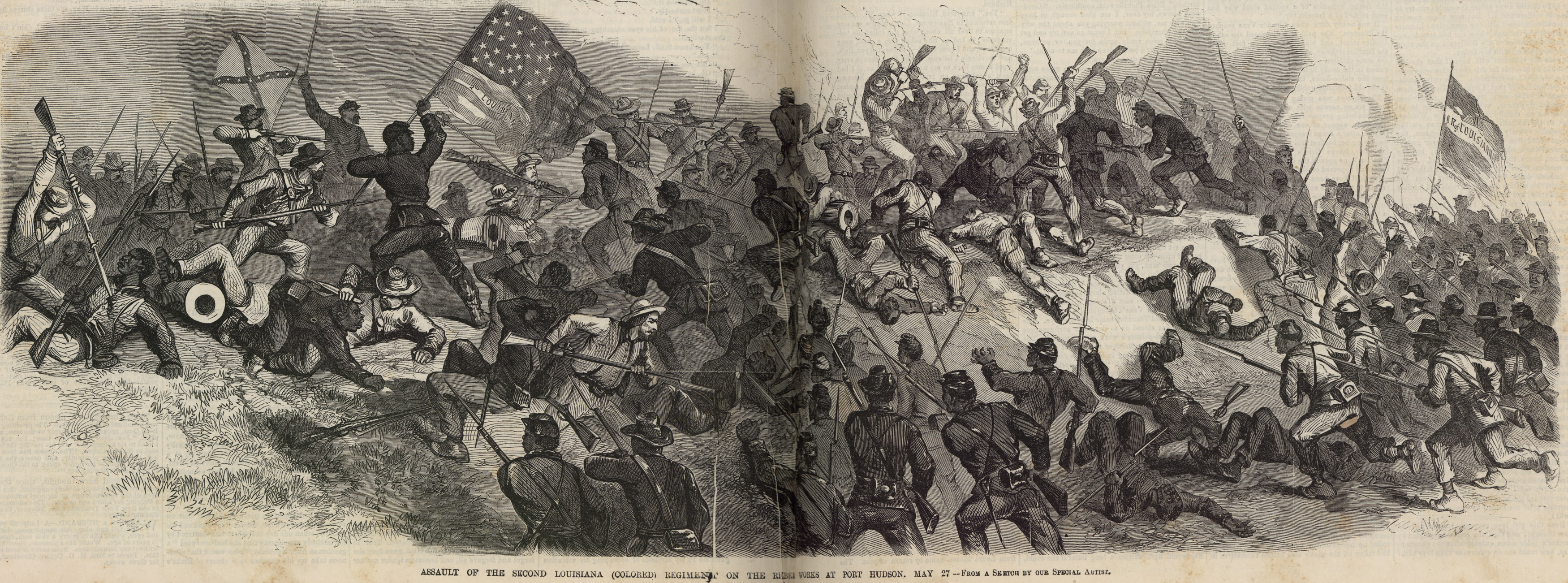
In addition to Miliken's Bend, I learned that Black soldiers would also  play a major part in the seige of Port Hudson, in May 1863.  Civil War illustrators for Frank Leslie's Illustrated Newspaper, captured an image of the seize of Port Hudson involving Louisiana's Black soldiers in 1863.

Assault of the 2nd Louisiana Colored Infantry on the Iron Words at Port Hudson

References to Louisiana's rich Civil War history, must include the Corps d'Afrique, the name originally given to these soldiers of African descent from that state.  

In some photos, such as this one, Black Louisiana Union soldiers were identified as Corps D'Afrique


At the New York Public Library, Image Gallery in the work, "Soldiers of the American Army, 1775-1941, a rare color drawing of Corps d'Afrique soldiers in uniform is found.

This image is a rare drawing of Corp D'Afrique Uniforms

Louisiana has a rich Civil War history, and beyond the 39 black Union regiments from the state there were the thousands of men, women and children who resisted and who made it to the line as contrabands. Man worked at the encampments as scouts, spies, laundresses, nurses, field hands, blacksmiths and teamsters. Their untold stories now lie buried in the soil where these proud Louisiana people now rest. 

This list of regiments is merely to mention them to catch the attention of sons and daughters of Louisiana and and hopefully Louisiana descendants will fully embrace them and truly tell their stories.

Sunday, June 19, 2011

Lessons Learned from Contrabands at Camp Nelson


* * * * *    * * * * *    * * * * *

I just had the experience of attending the week long Institute for Genealogical and Historical Research in Birmingham Alabama, on the beautiful Samford University Campus.  I participated in Course 8: Land Records: Using Maps.

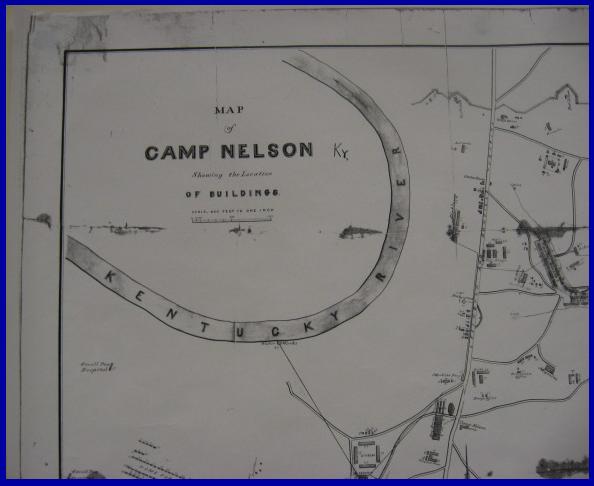
We discussed many things including military maps. Examples of all kinds of military maps were shown, but one map caught my eye immediately.  It was a map of Camp Nelson, in Kentucky.

Map of Camp Nelson

The camp had been surveyed and platted by A.B. Miller, one of a small number of engineers approved by the government to survey military lands.

Map was platted and surveyed by A.B. Miller

The map is part of the National Archives Record Group 92 and the image is map number 74


But what caught my attention is that the map also reflected the presence on the military base of a community of refugee slaves.  This was, in fact, a contraband camp.

Map reflected "home for colored refugees"

I studied the map and became interested in the size.  The scale indicated that 1 inch was equal to 400 feet. By measuring the length of the refugee site, I was able to learn that the camp for former slaves was more than 1000 feet in length. It appeared that by the time the map was made, the camp no longer consisted of tents, but of separate dwelling for each family. 

Of course having a strong interest in contraband camps I decided to learn more about the Camp itself. Could I possibly learn something about the lives of the refugee slaves? 

Well I played with the name of Camp Nelson, and discovered a book, by Richard D. Sears.  His book is called  simply "Camp Nelson, Kentucky".  

Book by Richard Sears 

The book is a true gem for it also described how freedom was brought to many of the refugees and how they learned officially of their status:


(Image of text from Sear's book)

In March of 1865, several hundred refugees had occupied the camp and it was decided to move from the temporary tents to the use of wooden structures to serve as temporary homes for the refugees. Order was being established and the word was sent out by the superintendent of the camp that teachers were needed, as well.

Excert of letter from Sears book.  Letter appears on page 185 of book.


Some of the stories about the former slaves appear in the book, taken from official records.  On page 186 he tells the story of Martha Cooley, a slave of John Nave of Garrad County Kentucky.


(Excerpts taken from book by Richard D. Sears)

There were so many stories of the trials and agonies of the slaves who described the beatings and horrors of Kentucky slave holders who tried to prevent their slaves from escaping. Many stories described horrific beatings given to female slaves whose husbands had enlisted in the Union Army. But nevertheless, some did make it though and although conditions were harsh also at the contraband camp, with disease, Camp Nelson was still their portal to another life.

As I continued to read more, I was even more delighted to discover online, an actual image of the Camp Nelson Contraband Camp.


One of the points made in the week long course on maps at Samford, is that many maps tell stories.  This proved to be true, and it took me to an experience where I learned more about the lives of those slaves who escaped.  

I have such joy to learn of those who made it to freedom. And my heart aches for those who stayed behind and could not leave. Their fate was a painful one at the hands of angry masters in so many cases.

I never would have thought that a week long seminar on maps would provide another opportunity to learn more about some dimension of the lives of the ancestors.  

And on this day when we celebrate freedom, I  salute the Ancestors and thank them for their strength and endurance. 

It is upon their shoulders that I stand. And so, I shall continue to trace the footsteps of the Ancestors.

Thursday, June 9, 2011

When Black Soldiers Met Stand Watie's Soldiers


As one who researches both US Colored Troops as well as the Black soldiers who served with the Indian Home Guards., I have often wondered about the fate of black soldiers when they came into combat with the Indian Confederate units.

The Indian Confederates were from the Five slaveholding tribes---Cherokee, Choctaw, Chickasaw, Creek and Seminole nations. These tribes signed an alliance with the South at the beginning of the Civil War, in 1861.  One of the leaders of the Cherokee Confederate units was Stand Waite, the well known Cherokee leader and slave holder himself.  

Stand Watie was the only Indian with the rank of general in the Confederate Army. 

As noted before, there were many Confederate regiments from Indian Territory---and among them were the Cherokee Confederates:

Cherokee Confederates:
-1st (Watie’s) Cherokee Mounted Volunteers
-2nd Cherokee Mounted Volunteers
-Drew's Regiment (1st Cherokee Mounted Rifles)
-1st Bryan's Batallion
-1st (Holt’s) Squadron,Cherokee Mounted Volunteers
-Frye’s - Scales’ Battalion,Cherokee Mounted Volunteers (1st Battalion, Cherokee Mounted Rifles)
-Cherokee Battalion, Thomas’ North Carolina Legion (2nd Battalion, Thomas’ Legion; Indian Battalion)


The first unit mentioned above was that of the Cherokee Mounted Volunteers---this unit was commanded by Stand Watie. There is a lot that is known about Watie himself, including the fact that he owned slaves.  The 1860 Slave Schedule reflected his ownership of slaves.

1860 Slave Schedule Reflecting Slaves of Stand Watie

I am fully aware of the rich history of the former slaves from the T.erritory who went into Kansas and joined the Union Army. Some joined the 1st and 2nd Kansas Colored, which later became the 79th and 83rd US Colored Infantry.  I have identified a few more than also joined the Indian Home Guards.  

I have often wondered if any of these regiments ever came into contact with the Indian Confederates and if so, how did they engage?  Especially when the regiments were commanded by slave holders such as Stand Watie---how were enemy soldiers treated?  Did they experience the same rage as was experienced by the soldiers at Ft. Pillow?  Did they come close enough to have had that kind of contact?

I found an answer when I was not looking for it.  While examining records of the 11th US Colored Infantry, a regiment organized in Ft. Smith Arkansas, I saw the service record of a soldiers that had died in a battle involving Stand Watie's regiment. The record was that of Stephen Arbuckle. 

Part of the military service file of Stephen Arbuckle, of the 11th US Colored Infantry


I continued reading and noticed that Pvt. Arbuckle was at the Battle of Gunter's Prarie in the Cherokee Nation.  At some point in the battle he tried to retreat from danger when he was captured and killed.  The manner of his death however, was a bit painful to read, and it answered a question that I had had---how were black soldiers treated by Indian Confederates when captured.

Document describing death of Pvt. Arbuckle

The soldier was not shot, but died by knife wound and mutilation. Was this standard? I can understand that in those circumstances where arms are down and soldiers did on many occasion engage in hand to hand combat.  Thus knives and any other weapons are used in those moments of intense crisis.  But beyond the fighting that brought death to an enemy soldier---was disembowelment a part of the standard combat?  

Or was this the kind of death such as that of Pvt. Arbuckle, the result of rage?  

Ft. Pillow taught us the degree of rage in which those who thought themselves superior as human beings, to black soldiers, went further than required to meet enemy soldiers. The very presence of former slaves as armed men brought forth a rage so strong that heinous acts occurred on the battlefield.

Did the Cherokee soldiers under Gen. Watie also have the same kind of rage that was repeated at Ft. Pillow, Poison Springs, Saltville and other battlefields?

There is no easy answer, except that Pvt. Arbuckle paid the ultimate price for his freedom, and that of others.
His record, like that of so many demand our attention, and reflect our need to look at the lives of the most ordinary of men, to learn to the greater lessons of human kind. For me, the lesson is that there are times, in which one must fight for causes that matter. 

No cause is greater than that of Freedom. Rest in peace Private Arbuckle.