Saturday, April 30, 2011

Remembering Jenkins Ferry

When General Frederick Steele sent a large contingent of Union soldiers into the Camden Arkansas area, there were black soldiers among them from the 1st and 2nd Kansas Colored Infantries.  After a major military campaign, Steele led the Union forces into southwestern Arkansas. The plan was to join forces with another battalion of Union soldiers to secure northern Louisiana and then move to secure southwestern Arkansas before moving into Texas. 

However, the Union Army forces in northern Louisiana had suffered defeat at Confederate hands, now leaving General Steele's Union soldiers less secure than had been planned.  In addition, the Union forces were suddenly very low on supplies.

General Frederick Steele
Source:  Library of Congress, Civil War Photograph Collection, Photographs Division

Earlier in the month, Steel had occupied the area around Camden Arkansas, but his forces had lost many men at Poison Springs, and at an incident at Mark's Mill.  Steele had to turn his forces back towards Little Rock. After a heavy rain had fallen, Steele's troops were crossing the flooded waters of the Saline River, when suddenly they were attacked, and the battle had begun.

The confederate leader, Edmund Smith had launched the attack, and the battle began in knee deep waters. Although the Union forces were able to hold off the attack long enough to cross the swollen river, they were not able to secure the area, and had to retreat back northward towards Little Rock. The battle was fought with many injuries to both sides.

Illustration depicting the Battle of Jenkins Ferry

The ambulance corps from the 2nd Kansas Colored had been ordered to collect some of the wounded, when they too were ambushed. Many died and many were injured in the process. Steele eventually got most of his forces across the river and ordered his men to destroy the pontoon bridge. From the Union Army over 700 men were killed or reported missing, and it is said that close to 1000 men from the confederate army also died.  

It is said that at this battle of Jenkins Ferry, men from the Kansas Colored were motivated by their battle cry, "Remember Poison Springs" and that some engaged in revenge killing of the enemy retaliating for their comrades killed at Poison Springs. 

The south was successful in controlling the area, forcing a retreat of Union soldiers back towards Little Rock. However, the forces under the control on Gen. Steele were still intact including the men of the Kansas Colored, and they would meet the enemy again in Arkansas, and later Indian Territory later the same year. 

I share this story on this day, in honor of my ancestor John Talkington, who was injured at Jenkins Ferry.
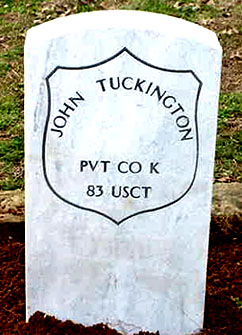
Pvt John ( AKA Tuckington) Talkington
In Memory of John Tuckington (Talkington), my ancestor, wounded at Jenkins Ferry


Sunday, April 24, 2011

When Dey Listed Colored Soldiers


***************************************
***************************************

Someone recently asked if anyone had a favorite Civil War poem. Well I do have a favorite Civil War Poem It was not written during the War, but after the war, by noted poet Paul Laurence Dunbar.  

I have loved the poem because it puts a human face on the hundreds of black soldiers who enlisted in the Union Army during the Civil War years. The poem was published in 1911 in the book Candle Lightin' Time  by Dunbar. For many years I have owned and treasured my first edition copy of that book.

Told from the perspective of an enslaved woman, she speaks about her husband Elias, whom she lovingly calls, 'Lias. She speaks about the time that, "dey listed colored soldiers, and her 'Lias went to war." Written in the old then called  " negro dialect" it reflects the southern cadence in which many slaves spoke, and it captures the sounds and the times as they were.


With this beautiful poem, photographic images were also published, all taken by the Hampston Institute Camera Club.

In honor of my ancestors who were among the many who joined when "dey listed colored soldiers",  I gladly share this poem so well written by Dunbar.  (His own father Joshua Dunbar was also one who enlisted in the US Colored Troops.) Dunbar also wrote another poem about black Civil War soldiers, called simply "The Colored Soldiers".  This one, however, speaks to me the most.


DEY was talkin' in de cabin, dey was talkin' in de hall;
But I listened kin' o' keerless, not a-t'inkin' 'bout it all;
An' on Sunday, too, I noticed, dey was whisp' rin' mighty much
Stan'in' all erroun' de roadside w'en dey let us out o' chu'ch.
But I did n't t'ink erbout it 'twell de middle of de week,
An' my 'Lias come to see me, an' somehow he could n't speak.
Den I seed all in a minute whut he'd come to see me for; --
Dey had 'listed colo'ed sojers an' my 'Lias gwine to wah.


Oh, I hugged him, an' I kissed him, an' I baiged him not to go;
But he tol' me dat his conscience, hit was callin' to him so,
An' he could n't baih to lingah w'en he had a chanst to fight
For de freedom dey had gin him an' de glory of de right.
So he kissed me, an' he lef' me, w'en I'd p'omised to be true;
An' dey put a knapsack on him, an' a coat all colo'ed blue.
So I gin him pap's ol' Bible f'om de bottom of de draw', --
W'en dey 'listed colo'ed sojers an' my 'Lias went to wah.


But I t'ought of all de weary miles dat he would have to tramp,
An' I could n't be contented w'en dey tuk him to de camp.
W'y my hea't nigh broke wid grievin' 'twell I seed him on de street;
Den I felt lak I could go an' th'ow my body at his feet.
For his buttons was a-shinin', an' his face was shinin', too,
An' he looked so strong an' mighty in his coat o' sojer blue,
Dat I hollahed, "Step up, manny," dough my th'oat was so' an' raw, --
W'en dey 'listed colo'ed sojers an' my 'Lias went to wah.


Ol' Mis' cried w'en mastah lef' huh, young Miss mou'ned huh brothah Ned,
An' I did n't know dey feelin's is de ve'y wo'ds dey said
W'en I tol' 'em I was so'y. Dey had done gin up dey all;
But dey only seemed mo' proudah dat dey men had hyeahed de call.
Bofe my mastahs went in gray suits, an' I loved de Yankee blue,
But I t'ought dat I could sorrer for de losin' of 'em too;
But I could n't, for I did n't know de ha'f o' whut I saw,
'Twell dey 'listed colo'ed sojers an' my 'Lias went to wah.


Mastah Jack come home all sickly; he was broke for life, dey said;
An' dey lef' my po' young mastah some'r's on de roadside, -- dead.
W'en de women cried an' mou'ned 'em, I could feel it thoo an' thoo,
For I had a loved un fightin' in de way o' dangah, too.
Den dey tol' me dey had laid him some'r's way down souf to res',
Wid de flag dat he had fit for shinin' daih acrost his breas'.
Well, I cried, but den I reckon dat 's whut Gawd had called him for,
W'en dey 'listed colo'ed sojers an' my 'Lias went to wah.

* * * * * * * * * *    * * * * * * * * * *    * * * * * * * * * *

This poem has always touched me.  I have two gr. grandmothers who lost their loved ones in the Civil War, and I dedicate this poem to them.  

Amanda Young Barr, lost her husband Berry Young, left to join the US Colored Troops. With him went her father and son as well. None were ever seen again.

Lydia Walters Talkington, whose husband John Talkington (Tuckington) joined the 83rd US Colored Infantry was severely injured at Jenkins Ferry and died from his wounds.  This week will mark the anniversary of the battle of Jenkins Ferry.

For these women, and these men, and those who loved them, I appreciate the fact during that difficult time, that indeed,  "Dey Listed Colored Soldiers" and my kinsmen, went to war."

* * * * * * * * * *    * * * * * * * * * *    * * * * * * * * * *

Pvt John ( AKA Tuckington) Talkington
Headstone - John Tuckington (aka Talkington)
(Photo Taken by Tonia Holleman)

Rest in Peace John Talkington, you are still remembered as I call your name.

Berry Young, Rest in Peace wherever you may be.


Monday, April 18, 2011

"Remember Poison Springs!"

Image from Encyclopedia of Arkansas


**********************************************

**********************************************


From the perspective of Black Union Soldiers the Battle of Poison Springs Arkansas would become the catalyst for a more determined effort in their battle for freedom. Simply put--it became their battle cry! The 79th US Colored Infantry was remembered by black soldiers on the western frontier throughout the remainder of the war, and is said to have propelled the Kansas Colored and later 83rd US Colored soldiers to victory from that point forward.

It should be noted that many of the soldiers of the 1st Kansas Colored were former slaves from Indian Territory, and the among the confederate soldiers that they confronted were former slave holding Indians from the Choctaw Nation.  (Choctaws along with the other tribes from the Trail of Tears, were also owners of African Slaves, and this was the first major battle in which former slaves from these tribes would meet former slave holding Confederate Indian regiments. They would later engage the Indian confederates at Honey Springs, Indian Territory in the same year.)

At Poison Springs Arkansas, General Frederick Steele had ordered a foraging expedition of about 600 men to gather corn from area farms and plantations, to address the Federal forces shrinking supplies. About 18 miles from Camden Arkansas the forces which included members of the 1st Kansas Colored (later known as the 79th US Colored Infantry) were to supply of many wagons with corn in order to secure much needed food. The Union soldiers were said to have been ambushed by Confederate forces that had outnumbered this smaller band of Federal soldiers. With approximately 3600 men, the Federal soldiers were attacked.

Official records indicated that at first, the Kansas Colored fought off two of the attacks..  The Confederate forces were then joined by the Choctaw Brigade, a Confederate unit led by tribal leader Tandy Walker, forcing the Union soldiers into retreat. As the Union soldiers retreated the fighting was halted.

Tandy Walker, Choctaw leader, & Confederate General.  He led the brigade at Poison  Springs

As the soldiers retreated, attention was then given to the injured black soldiers of the Kansas Colored.  The sight of black men in uniform often brought out immediate rage from Confederate soldiers.  And as had taken place at Ft. Pillow,  and later Saltville and other places, the injured black soldiers were seldom taken prisoner--they were slaughtered.

It has been explained by some historians that the very sight of black men, who throughout the lifetime of many southern soldiers had been held in a lesser societal status, to now see them now fighting equally as men, immediate rage, rose from their inner core, and no military training would allow them to treat these former slaves as prisoners---their rage would take over, and men from Ft. Pillow, to Poison Springs would pay the ultimate price for freedom. No protocol would be followed, no quarter would be given to those men, and on that fateful day in Arkansas, many of the men of the 1st Kansas Colored would become martyrs in their own fight for freedom.

[For a useful reference on the treatment of black soldiers, and understanding of the emotional reasoning behind these events, this following work is recommended as a guide to understanding the motives behind massacres at places like Poison Springs, Ft. Pillow, Saltville and others:
Urwin, Gregory J. W. “‘We Cannot Treat Negroes… as Prisoners of War’”: Racial Atrocities and Reprisals in Civil War Arkansas.” In Civil War Arkansas: Beyond Battles and Leaders, edited by Anne Bailey and Daniel Sutherland. Fayetteville: University of Arkansas Press, 1999]


For the remainder of the Civil War, Remember Poison Springs became the battle cry of Black soldiers, on the western frontier.


(Today an artifact of the Kansas Colored still exists---one of the flags of the Kansas Colored has been preserved by the State of Kansas, where they were organized.)


DESCRIPTIONS OF WHAT HAPPENED AT POISONS SPRINGS
EXCERPTS FROM THE OFFICIAL RECORDS OF THE REBELLION:


Description of the Kansas Colored at the battle:


These excerpts were taken from:


A few months later this battle cry was heard at Jenkins Ferry.  I have an ancestor who died  after receiving wounds the Jenkins Ferry Battle. He served with the 2nd Kansas Colored, (later known as the 83 US Colored Infantry). Being part of an ambulance corps from the 2nd Kansas, he would most likely have heard that Poison Springs battle cry from his comrades, though as fate would have some of them to fall to the enemy, that battle cry would be heard for the remainder of the war. And although my ancestor lost his life in the battle, the greater battle for freedom was still won. And as I think about him, I honor the battle cry that propelled him, for I also remember those from brave men the 1st Kansas Colored who paid the ultimate price on this day, April 18th 1864.

Today, I remember Poison Springs!

Monday, April 11, 2011

Tennessee Black Soldiers Honored at National Cemetery


As one who has six ancestors from Giles County Tennessee who served with the 111th US Colored Infantry, I was delighted to see this wonderful video about a monument dedicated to the honor of the US Colored Troops at the National Cemetery in Nashville! My ancestors were from Giles County Tennessee, served with the 111th US Colored Infantry and were captured at Sulphur Branch Trestle in September 1864.

Sephus Bass, his brother Braxton Bass and his own two sons Henry Bass and Emmanuel Bass, all joined together. Another close relative Thomas Bass also served in the same unit, In addition to that, there were two who had married sisters of my Uncle Sephus--James and William Oddaway who were also in the 111th. So that is seven all from Giles County who joined the Union Army.

I was pleased two years ago when researching for a  man who happened to be the mayor of one of the cities in Arkansas, and to discover that his family roots are tied to North Alabama.  I became interested in his history and I was most surprised to see that his own family had served in the Union Army with mine. In fact he had 17 ancestors that had joined the 110th US Colored Infantry and 2 who had joined the 111th US Colored Infantry.  What a legacy! Of the 17 men connected to him, 7 of them were either corporals or sergeants.

Both regiments fought in the same area, both were captured at Sulphur Trestle, Alabama, and his direct ancestors  were living in Giles County immediately after the war.  They more than likely knew my own ancestors!

I have learned how so many men joined in groups when so many were seizing their own freedom after the Bureau of US Colored Troops were established.

As much as I research USCTs I have seen so few monuments devoted to these men.  I am so happy to see Tennessee honor these men at the National Cemetery.  My goal is to visit that cemetery, to see the monument, and to see the grave sites of the men who served with my ancestors all brave men, who fought for freedom.

Wednesday, April 6, 2011

What an Impression They Must Have Made: the 11th US Colored Troops of Ft. Smith Arkansas


Rare Image of US Colored Troops on Parade
1st US Colored Cavalry on Parade
Source: Library of Congress


In November 1864, the US Colored Troops were on parade in Ft. Smith Arkansas where they were organized.  An article appeared in the newspaper describing them and the impression that was made on the local population in the community.  


FORT SMITH NEW ERA  November 5, 1864, 

The Second Brigade.

 Last Monday the colored troops were in all their glory.  The 2d Brigade was on review, and presented an appearance that made every loyal heart throb with pleasure, and every rebel that saw the "darks," tremble when he remembered that "God is just," and that it was for the perpetual enslavement of these black patriots that this rebellion was inaugurated.  Every man was in his place, and stepped with the music as if he felt the whole thing depended on himself.
            
The 1st and 2d colored are as well drilled as any regiments in the District, if not better than any, and their movements on Monday were a credit to the blacks as well as the noble men who command them.  The 11th and 54th are of more recent organization, but are well drilled and ready for double their number of rebs at any time.
           
 It is but two years since the 1st colored was raised and then months passed before it was fully organized and its officers commissioned.  Then but few thought it possible for any good to come out of the movement, and the whole Copperhead fraternity and a good many weak kneed Republicans cried out against it.  "It was well enough to put them in the ditches with spades in their hands, but to arm and drill the nigger and thus make them the equals of white soldiers was outrageous," while at the same time the colored man is by far the superior of any copperhead or rebel.  They said the "nigger was a coward, wouldn't fight, and that a white man with a whip in his hand could run a dozen blacks though armed with the minnie."  How has it turned out?  Has any company of the 2d Brigade ever showed the least sign of cowardice though some of them have at different times been attacked by three times their numbers?  No!  and every man that saw them last Monday acknowledged to himself that they were more than a match for the same number of rebels in any open field fight.

 Two years ago none but men of true moral as well as physical courage would accept positions in colored regiments.  All honor to the Officers of the 1st Colored, who, disregarding the sneers of the world, and risking their chances of being commissioned and the threats of assassination by the rebels if they were ever taken, went forward in the path of duty and won for themselves and their men an honorable positon in the grandest army in the world.
            
"Look out dar" rebels, when you come in contact with the 2d Brigade, for they're "gwyne to shoot." 
(The article appeared on page 2 column 2 in the newspaper in 1864.)

* * * * * * * * * *

A Tennessee Regiment on Parade
Source:  Library of Congress

Thursday, March 31, 2011

"Black Bellied Yankees" Made Their Mark at The Battle of Ft. Blakeley

Image of the Battle of Ft. Blakely


Imagine a Civil War battle in which more than 6000 black soldiers emerged victorious. Such is the story of the Battle of Ft. Blakely in Alabama. Just hours from the time of Lee's surrender, there was much activity in many parts of the south including Alabama.

Among the many units involved in this battle was the 46th US Colored Infantry.  One of the white commanding officers was Colonel Frederick Mortimer Crandal.  He described the black soldiers in a personal letter, and described the unit he commanded as "Black Bellied Yankees" who "made their mark."  

Image from letter written by Colonel Frederick Mortimer Crandal


The first Union soldier to advance to the line are said to have been the 73rd and 86th US Colored Infantries. The 73rd US Colored Infantry was known originally as the 1st Louisiana Native Guards, the regiment was later re-designated as the 73rd US Colored Infantry. Both of the units were described as extremely successful in fighting off Confederate forces. One of the black soldiers in that battle happened also to be only black officer known to have been serving on the Blakeley Battlefield.  His name was Captain Louis A. Snaer, who had been a free man of color in Louisiana, before the war.

Portrait of Capt. Louis A. Snaer in Civil War Uniform
Before the war he was a free man of color in Louisiana
Image from descendants of Louis A. Snaer.

He was wounded at the seige of Ft. Blakely, and was treated for his wounds. He did survive the war, and later moved westward to California where he died in 1917.


It is said that after this battle some former slaves encountered former slave masters. In one case the slave and former slave owner expressed some pleasure in encountering each other.  It is also said that in some cases USCTs after the battle and prisoners taken, that some former slaves attacked some of the white prisoners, for deeds administered to them previously while enslaved. 


Today the battle site is an historic park . On the site one can find an organizational list of the USCTs that fought at Ft. Blakeley.  The story of the siege of Ft. Blakely is indeed an interesting one, and it is among the many stories to tell about the history of the US Colored Troops.

This was the last battle of the Civil War in which US Colored Troops were said to have played a major role.


Monday, March 28, 2011

Finding The Civil War Era Stories Around Us

* * * * * * * * * * * * * * * * * * * *
* * * * * * * * * * * * * * * * * * * *

Someone asked me recently how I was able to find out about much of the local Civil War history that I write about.  This was a valid question, especially since much is not written about nor presented in the standard history curriculum. The question arises---how do you know if you should delve into Civil War History?  

Well my answer is simple---if the war affected the region where you lived---and if your ancestors were impacted---then one should by all means study the events as they occurred on the local level in particular.

So----where are the clues and how can you find out? Well, many clues to our history are all around us----right in the communities where we live.  We only have to open our eyes to learn see them. Every community has a rich history and even if you own community or that of your ancestors is not discussed in a textbook sense, there is still data to be found, anyway. We only have to let our eyes see it! Look at your local community with a new lens.


Was your ancestral community a site where any historic battles took place?  If so--- were there any black soldiers at that battle?  Years ago this would have been difficult to answer---but today that is not a difficult task.  So ask the question and see what you find.


This historic marker reflects activities the 1864 campaign against Petersburg. There 22 black units
involved in the events around Petersburg VA, from June 1864 - April 1865

 If there was a battle in the vicinity---that tells you several things.

For there to have been a battle:
1) There had to have been Union soldiers. 
2) If there was a Union regiment in the area, there was a Union encampment---a Union line.
3) If there was a Union line, there is also the possibility of sanctuary---a contraband camp might have been nearby.
4) If there was a large plantation or estate in the area, there might have also have been right after the war, a local field office of the Freedman's Bureau----thus leading to new records and a new source of data including labor contracts with newly freed slaves.
5) If there was a large estate, and a presence of Union soldiers---there was also the possibility of a regiment of US Colored Troops being organized in the same area.


Are there historic antebellum homes? Then there is another opportunity for research.

An historic home--Heyward House, Bluffton SC

In those communities if there were any antebellum homes---then there was a community of people who were enslaved who worked in those homes and also upon the grounds of the estate.  Even if your ancestors had no ties to the estate--someone in the community did have ties, and knowledge of the community's history involves working on the history of those tied to those estates.  


If there are other historic sites---an old mills, historic buildings, churches, and courthouses, there are opportunities for researchers to obtain more data on their own people. Such places were often worked on by enslaved people in the area---so there is more data to explore.

Old churches often reveal information about slaves, in those cases where slave holders allowed slaves to have services.

There are many stories around our ancestral homes, and by placing our ancestors back on the landscape and understanding that their lives unfolded right there----we must begin to look at communities differently as we pass them by.

Thankfully---more historic markers are also appearing on the landscape reflecting in incidents that involved the fight for freedom made by our ancestors who were soldiers and who were enslaved people seeking their freedom. 

We must simply learn to look at those landmarks as we pass them by.

Historical marker in Nashville area.

 
Marker honoring the 1st Regiment Kansas Colored, Rentiesville, Oklahoma