Thursday, March 29, 2012

The Words, Actions and Life of Spottswood Rice - Freedom Fighter (Part 1)

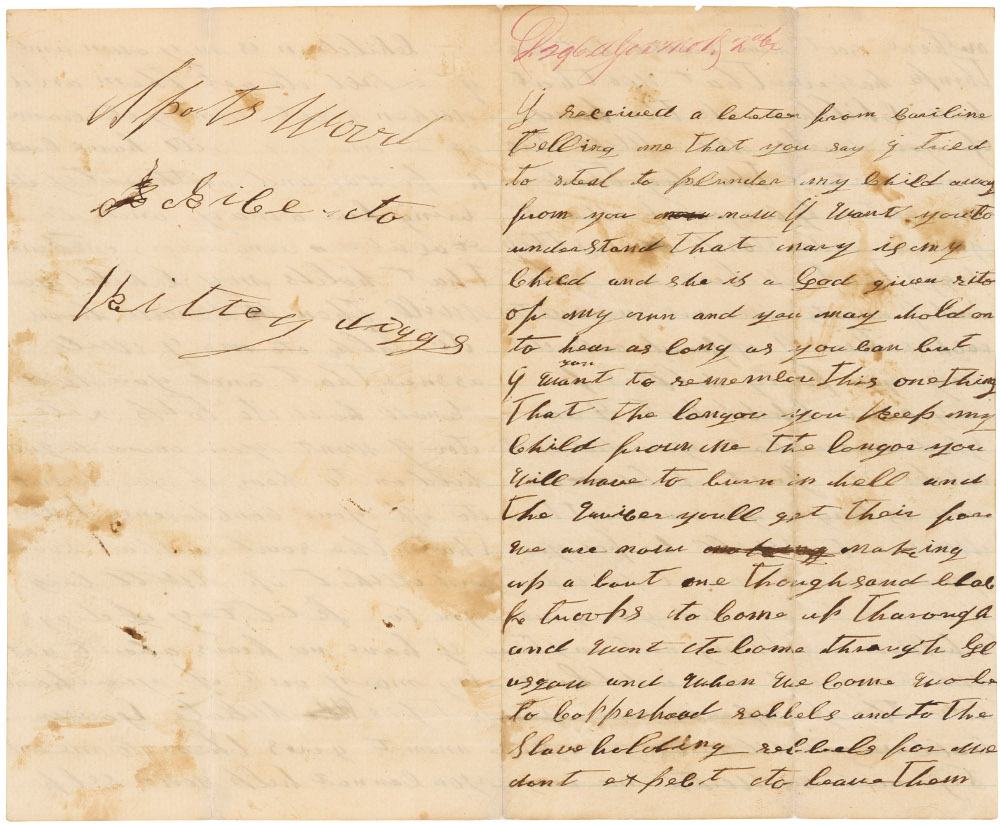
Portion of Letter From Spottswood Rice to Former Slave holder Kitty Diggs
(Click on image to see digitized image of original letter)
Source: 
The letter above was written by a father whose concern was the status and freedom of his daughter. His name was Spottswood Rice and he had left the estate of Benjamin Lewis in Howard County, and made it to the Union line not far from Glasgow Missouri. Months later, as many slaves were making a break for freedom, and many were striving to reunite their families, Spottswood Rice had made such an effort. His daughter Mary, however, was still enslaved.  This remarkable letter illustrates the determination of a strong willed man whose spirit was never broken by the yoke of slavery.

The slave holder was Mrs. Kitty Diggs. The wife and children were held by the Diggs family, and it appears that when he wrote the letter, he was still struggling to obtain freedom for his daughter Mary. He begins his letter with a strong and stern warning to the woman holding his daughter in bondage.

"I received a leteter (from Cariline telling me that you say I tried to steal to plunder my child away from you now I want you to understand that mary is my Child and she is a God given rite of my own and you may hold on to hear as long as you can but I want you to remembor this one thing that the longor you keep my Child from me the longor you will have to burn in hell....

Wow---such powerful words. Spottswood had found freedom and had enlisted in the 67th US Colored Infantry in Glasgow Missouri.

Service Record of Spottswood Rice, Pvt. 67th US Colored Infantry
Source: Compiled Military Service Records of Volunteer Union Soldiers Who Served the United States Colored Troops: 66th-82nd USCT Infantry, 1864-1866.  (Image from Fold3.com)

But the letter from Spottswood Rice to the slave mistress is one of the more forceful letters that I have ever seen.  This letter was recently shared in one of the communities on Facebook for African American genealogists. Everyone who read the letter and commented about it was truly amazed by its tone and everyone, including myself immediately embraced this man for his spirit and determination to be with his family again. From his service record (above) it is noted that he was born in Virginia and was by the time of the war, a mature man in his late 30s. Having been born in Virginia and ending up 30 years later in Missouri, suggests that he could have already had a taste of separation from loved ones. Slaves lived and died at the mercy of their slave holders, and often loved ones were removed, sold, and kept from each other for years, and in some cases for life.

What a surprise to find a copy of a bill of sale pertaining to Spottswood when he was a young lad, being sold from one man to another slave holder Benjamin Lewis in Howard County, Missouri. This unxpected document was actually included in his military service record. This transaction took place in 1843.

Item found in Military Service Record Reflecting the Sale of a young Negro boy Spottswood.

It is possible that the slave holder was compensated for "allowing" Spottswood to enlist. 

One must remember that although it was a slave state, Missouri did not secede from the Union, so slavery was quite legal. 

I also learned, while researching a bit of Missouri history that if a slave holder was considered "loyal" to the Union and could actually prove that he owned the slave enlisting, then in the state of Missouri, the slave holder was compensated for the slave and for the loss of the slave's labor. So perhaps this receipt may have actually been given to the enlisting officers to prove ownership from a "loyal"  slave holder. The slave holder would have been eligible for a $300 payment for allowing his slave to enlist.

However, by the time this letter was written---he was a man in freedom, who was now demanding the freedom of his daughter Mary, who it appears was still being held.

His letter continues...........

.......that the longor (sic) you keep my Child from me the longor you will have to burn in hell and the qwicer (sic) youll get their (sic) for we are now makeing up a bout one thoughsand (sic) blacke troops to Come up tharough and wont to come through Glasgow and when we come wo be to Copperhood rabbels (sic)....

There is a possibility that Spottswood may have been freed before enlisting in the Union Army. He stated in the letter that he had tried to purchase his child Mary but Kitty Diggs had refused his offer.

"..........my Children is my own and I expect to get them, and when I get ready to come after mary I will have bout a powrer and autherity (sic) to bring hear away and to exacute (sic) vengencens on them that holds my Child you will then know how to talke  to me"

What a surprise to even find a video where part of his letter was re-enacted.
Re-enactment of the words found in the letter of Spottswood Rice

So after reading that letter I had to know what other details about his life can be learned. 
Did he survive the war? Could his Union Army experience be documented further? Did he get his daughter Mary? How long did he live? And what was the nature of  his life?

Well, I was able to learn the answers to all of those questions. But one major part of the story has to be told. Spottswood Rice actually wrote two letters. He wrote one letter to his children and another letter to the slave holder--which I have already discussed. Written on the same day, it appears that Mary, the child cited in the previous letter was a child "left behind".  It also appears that possibly he was partially successful in reuniting his family, and Mary and possibly another child Cora were still missing from the family.

The previous letter written to his children still held by Kitty Diggs deserves to be discussed as well.

[Benton Barracks Hospital, St. Louis, Mo.  September 3, 1864]
My Children   I take my pen in hand to rite you A few lines to let you know that I have not forgot you and that I want to see you as bad as ever   now my Dear Children I want you to be contented with whatever may be your lots   be assured that I will have you if it cost me my life   on the 28th of the mounth. 8 hundred White and 8 hundred blacke solders expects to start up the rivore to Glasgow and above there thats to be jeneraled by a jeneral that will give me both of you   when they Come I expect to be with, them and expect to get you both in return. Dont be uneasy my children   I expect to have you. If Diggs dont give you up this Government will and I feel confident that I will get you   Your Miss Kaitty said that I tried to steal you   But I'll let her know that god never intended for man to steal his own flesh and blood. If I had no cofidence in God I could have confidence in her   But as it is If I ever had any Confidence in her I have none now and never expect to have   And I want her to remember if she meets me with ten thousand soldiers she [will?] meet her enemy   I once [thought] that I had some respect for them but now my respects is worn out and have no sympathy for Slaveholders. And as for her cristianantty I expect the Devil has Such in hell   You tell her from me that She is the frist Christian that I ever hard say that aman could Steal his own child especially out of human bondage
You can tell her that She can hold to you as long as she can   I never would expect to ask her again to let you come to me because I know that the devil has got her hot set againsts that that is write   now my Dear children I am a going to close my letter to you   Give my love to all enquiring friends   tell them all that we are well and want to see them very much and Corra and Mary receive the greater part of it you sefves and dont think hard of us not sending you any thing   I you father have a plenty for you when I see you   Spott & Noah sends their love to both of you   Oh! My Dear children how I do want to see you
[Spotswood Rice


Source of letter:[Spotswood Rice] to My Children, [3 Sept. 1864], enclosed in F. W. Diggs to Genl. Rosecrans, 10 Sept. 1864, D-296 1864, Letters Received, ser. 2593, Department of the MO, U.S. Army Continental Commands, Record Group 393 Pt. 1, National Archives. 
* * * * * 

Spottswood enlisted in the Union Army near Glasgow Missouri in February of 1864. While in the army, Spottswood suffered an injury and was sent to the military hospital at Benton Barracks to recover. I was quite surprised to find a document reflecting his hospital stay at Benton Barracks in his file.

Hospital Card From Benton Barracks Where Spottswood Rice was a Patient
Source: Compiled Military Service Records of Volunteer Union Soldiers Who Served the United States Colored Troops: 66th-82nd USCT Infantry, 1864-1866.  (Image from Fold3.com)

On that document the name of Spottswood's wife was revealed. Her name was Ary Rice. 

 Apparently, once the men had entered the ranks of the Union Army, they considered themselves to be truly free. By the fall of 1864, Benton Barracks had become a place of refuge--slaves were arriving continually at the Barracks and it became an encampment not only for slaves but for refugee ex slaves who had freed themselves. They were contrabands. Members of Spottswood's family were apparently with him by the fall at including his sons, but his daughters Cora and Mary were still being held by Kitty Diggs.

It should be noted, when husbands and wives were reunited, many of the soldiers wanted to have their marriages recognized and officially recorded.  And Spottswood, was such a man, also wanting to have his marriage officially recorded. And that was when I found a record I never expected to find---I found a marriage record of Spottswood. It appears that while there at Benton Barracks--he and his wife Arry, of many years, who were already parents, still managed to marry officially and have a record made, at long last of their union! 

Marriage Record of Spottswood Rice and Ary Ferguson, October 1864
Due to the faintness of the image, a transcription appears below
Source: Ancestry.com. Missouri Marriage Records, 1805-2002 [database on-line]. 
Provo, UT, USA: Ancestry.com Operations, Inc., 2007.
Original data: Missouri Marriage Records. Jefferson City, MO, USA: Missouri State Archives. Microfilm.


Partial Transcription

"This is to certify that I joined in marriage October 6, 1864 at Benton Barracks Spottswood Rice and Arry Ferguson, all of  the city of St. Louis, J. P. Ives Chaplain"

 I found the document on Ancestry.com's collection of Missouri marriages, and there appear to have been several dozen marriages performed at Benton Barracks during that time, presumably most were marriages of newly freed slaves legalizing their unions as last.

Did he survive the war? 

Yes---Spotswood Rice did survive the war, and was reunited with his daughter Mary. I found Spotswood Rice in the 1870 Federal Census in Missouri.

Spottswood Rice with Family in 1870
Source: Year: 1870; Census Place: St Louis Ward 11, St Louis, Missouri
Roll: M593_821; Page: 386B; Image: 256; Family History Library Film: 552320.

In the household with him was his wife and three children. His daughter Mary was indeed there in the household with them, along with two other children. Cora was not present and it is not known if she had died or was now married and living elsewhere.

I noticed in the 1870 census that Spottswood had apparently acquired some property as he had both personal property and real estate and the value of his property listed as well. I also noticed that of the persons in the household, in the column that indicated illiteracy of the person enumerated---his line was not marked---suggesting that he was a literate man.

Census form indicated that Spottswood was possibly a literate man

In 1880, Spottswood is living in Missouri with his wife and two sons, daughter Mary, who is now married with her own family. All share the same home on Elliott street in St. Louis.  Spottswood's life has also changed, for he is now listed as a minister by profession.

From this point, records reflecting the life of Spottswood Rice indicate that his life has taken a new direction since the years of enslavement. So--there is so much more to tell.

To be continued.......

(End of Part 1)

Monday, March 12, 2012

March: A Month of Battles for USCTs

More than 6000 Black Soldiers Participated in "Storming of  Ft. Blakeley" 
Last Major Battle of Civil War   
Source:  Harper's Weekly May 27th, 1865

The month of March was a time in which the soldiers who were part of the US Colored Troops found themselves engaged in a number of battles and skirmishes throughout the nation. The most impressive battle during the month of March was the Battle of Ft. Blakeley in which more than 6000 men of African Descent participated from nine different regiments.

As winter months melted into spring, the warmer weather provided more opportunity for movement of soldiers, thus bringing about more engagement with the enemy that the colder weeks had provided. As I began to look at my historical calendar, I decided to list the dozens of battles in which Black Union soldiers were engaged during the month of March, as their fight for freedom unfolded.

Several battles and skirmishes involved more than one regiment and the critical "last battle" of the war took place at Ft. Blakeley and thousands of Black men participated in that effort which lasted for several days.

In honor of the US Colored Troops engaged in March battles, they are listed here.

March  1,  1865  St. Stephens SC 55th Massachusetts (Colored)
March  2,  1864 Goodrich's Landing LA 66th US Colored Infantry
March  2,  1864 New Kent Courthouse VA  5th US Colored Infantry
March  4,  1864 Williamsburg VA  6th US Colored Infantry
March  5,  1865 Yazoo City, MS  3rd US Colored Cavalry & 47th US Col. Infantry
March  6,  1865 Natural Bridge FL  2nd US Colored Infantry and 99th US Infantry
March  8,  1865 "Alliance" Steamer, FL 99th US Colored Infantry
March  9,  1864 Suffolk VA, 2nd US Colored Cavalry
March 10, 1865 Marion County FL 3rd US Colored Infantry
March 15, 1865 Yazoo City MS  3rd US Colored Cavalry
March 18, 1865 Amite River LA 77th US Colored Infantry
March 18, 1865 Boyd's Station AL  101st US Colored Infantry
March 20, 1864 Pass Manchas LA 10th US Colored Heavy Artillery
March 20, 1864 Roseville Creek, AR 79th US Colored Infantry (New)
March 24, 1865 Cox's Bridge, NC 30th US Colored Infantry
March 24, 1864 Goodrich's Landing LA 66th US Colored Infantry
March 25, 1864 Ft. Anderson KY 8th US Colored Heavy Artillery
March 25, 1865 Brawley Fork TN  17th US Colored Infanntry
March 25, 1863 Glascow KY 119th US Colored Infantry
March 27, 1865 Spanish Fort AL 68th US Colored Infantry
March 29, 1863 Jacksonville FL 33rd US Colored Infantry
March 31, 1864 Roach's Plantation MS 3rd US Colored Cavalry
March 31, 1865 White Oak Road VA 29th US Colored Infantry
March 31, 1865 Ft. Blakeley AL:
     47th US Colored Infanty
     48th US Colored Infantry
     50th US Colored Infantry
     51st US Colored Infantry
     68th US Colored Infantry
     73rd US Colored Infantry
     76th US Colored Infantry
     82nd US Colored Infantry
     86th US Colored Infantry

May their legacy be remembered!

Thursday, January 26, 2012

Remembering the Teachers - Who Brought Thousands Out of Darkness

Mary Peake taught many former slave children underneath Emancipation Oak, 
on what is now the campus of Hampton University. 
Source of Image: Past is Present

In the civil war years as well as the years immediately after the war, so much needed to be done to stimulate the minds of children, especially those whose status as slaves had denied them a formal education.  

From the works of women like Mary Peake, of Virginia to the teachers of the Port Royal Experiment, to the countless hundreds of others who labored for years, these women deserve their place on a Roll of Honor of people who worked towards the effort of freedom through education.

Port Royal Teacher Laura Towne
Source: 

Mary Peake is one of the most well known--yet she is still unknown by many.  She was the daughter of a free black woman and an Englishman.  She was educated in Alexandria in the 1830s at a school for blacks in the District of Columbia. At that time, Alexandria was still part of the District of Washington. She began teaching in the 1840s from her home and later, after her marriage to Thomas Peake, a former slave, she moved with her husband  to Hampton Virginia. 

When the Civil War burned much of  Hampton, she found herself in a city among many newly freed slaves--known as contrabands. Many  had taken refuge at nearby Ft. Monroe. Others had lived in the Grand Contraband Camp in Hampton, established by Gen. Butler and Union forces, when Ft. Monroe had no more room. There she found herself in a city with hundreds of children wanting to learn. 

Projects emerged around the country and many organizations assisted in the process. The American Tract Society of Boston created a school primer for former slave children.

The Freedmen Spelling Book created by the American Tract Society of Boston

Even during the years of the war itself, thousands of men who had enlisted in the Union Army also set about the task of learning to read and write. So great was this desire to learn!

In Hampton, a project began with six students and then grew to dozens within a few days and Mary Peake immediately threw herself into her work. This was in the fall of 1861. She was often seen teaching children underneath a massive oak tree (now known as Emancipation Oak)

A small school structure was erected and she immersed herself into teaching over the next several months. As does happen with people often thrown into close contact, illness and disease occurs, and by winter, Mary Peake had caught tuberculosis after continuous weeks of work and constant exposure. Her illness progressed, during the winter but her constant desire was always for the children and to see that they would be taught. When she was first bedridden she was often known to still have children brought into her room and she would teach them from her bed. But eventually she could no longer teach. In February of 1862, she was finally overtaken by tuberculosis and died.

Mary Peake loved teaching and wanted to bring enlightenment into the lives and minds of the newly free slave children. Several months after her death, the black residents of the Hampton area were to hear the words of the Emancipation Proclamation read to them underneath the very oak tree where she taught new freed children of slaves. This was also the first public reading of the Emancipation Proclamation in 1863.

 Emancipation Oak, as it is known today still stands strongly on the campus at Hampton University. A few feet away from the trunk of Emancipation Oak  stands a small red schoolhouse said to be the Butler School building where Mary Peake and later other teachers taught.

Butler School Stands on Grounds Next to Emancipation Oak
Taken by Bernard Fisher, July 2010

The devotion of Mary Peake to teaching contraband children, and her devotion to her school became a model for other Freedman Schools throughout the South. 

From the teachers in Hampton to the Port Royal Experiment of the Low Country to the Freedmen Schools in Arkansas, teachers such as Mary Peake unlocked doors. The education of former slaves brought about the true ending of slavery to hundreds of thousands. Through education the shackles of bondage remained broken.

Emancipation Oak


Wednesday, January 11, 2012

General Burnside and Young Tom, a Contraband

Masthead for Frederick Douglass' Monthly, August 1862
Source: Accessible Archives, African American Collection

150 years ago in the month of February, a young man paddled his way to freedom in a canoe. It was said that "in that contraband's  hand, a victory was brought to the United States of America, led by Burnside."

I found this story of this young man, while looking at an issue of the Douglass' Monthly through Accessible Archives. What I discovered was the story of a  young many who rowed to freedom, who was befriended by General Burnside and who shared everything he knew about the countryside, allowing the General and his staff to map the area around Newbern , and to plan a military strategy that would lead to a major victory.


There were two things that stood out for me----first, the actions of the enslaved population are indirectly revealed--the enslaved people were fleeing to the Union lines and seizing their freedom. Secondly, this one young boy had a sharp memory--enough to allow General Burnside to map the area accurately and plan a military attack.
General Ambrose Burside
Source: Major General Ambrose Burnside, and the Ninth Army Corps
Providence: Sidney S. Rider and Brother, 1867
Online Edition of book available through Google Books

How wonderful that I was able to see such an interesting article in the Douglass Monthly. Although his name was not mentioned, I truly wanted to find out more about this courageous lad, and if his story was recorded any other place.

So after a careful Google Search, I came across an interesting work, called, Major General Amborse Burnside and the Ninth Army Corp, published in 1867. In that book, I found a full description of the same incident reported in Frederick Douglass' publication about the young boy, Tom. 

General Burnside was stationed near Hatteras, and calculating how to capture Roanoke Island. It is noted that a solution to his question rowed literally into his presence.

Source: Major General Ambrose Burnside, and the Ninth Army Corps
Providence: Sidney S. Rider and Brother, 1867, p 33
Online Edition of book available through Google Books


Tom proved to be a valuable aid to the officers assisting Burnside. He was able to describe the land, the location of troops on both sides and was able to assist the team of officers on the best place to land ashore.
 He was therefore treated well for his assistance, and was allowed to remain among the soldiers at Hatteras.

Source: Major General Ambrose Burnside, and the Ninth Army Corps
Providence: Sidney S. Rider and Brother, 1867, p. 33
Online Edition of book available through Google Books

Sure enough when the regiment sailed into the harbor to begin to take Roanoke, Tom led them to the spot where they disembarked and the plans unfolded.

Source: Major General Ambrose Burnside, and the Ninth Army Corps
Providence: Sidney S. Rider and Brother, 1867 p. 39
Online Edition of book available through Google Books


Another book mentioned young Tom and his impact on Burnside's operation. That book is called The Outer Banks of No. Carolina  1584-1958, by author David Stick. He refers to young Tom and the topographical engineer as the two heroes that helped to capture Roanoke Island.

What happened to Tom after the war? 

Did he survive the war, and live to see freedom?

Did he eventually move into the Freedman's Colony at Roanoke? No complete roster of the colony exists. But considering his relationship with the General and his staff, my hope is that he did survive the war, and begin life again and live to breathe free air in a time of peace. 

Young Thomas Robinson, like hundreds of other contrabands is one of may unsung heroes of the Civil War. His desire for freedom was fulfilled and he shared his skill and knowledge of the land with General Ambrose Burnside and his actions had direct impact on a major campaign in America's Civil War. The small article published by Frederick Douglass in 1862, provided a small glimpse into how even the most ordinary actions of one person can bring about change.

The sesquicentennial anniversary of young Tom's arrival at Hatteras will take place in February and I for one shall remember him as those days approach.

Union Army Overtaking Roanoke Island


Sunday, January 1, 2012

Continuing the Story--Soldiers, Contrabands and Their Freedom

20th US Colored Infantry Presentation of Colors

The celebrations continue.

Last year marked the beginning of a five year campaign to commemorate the story of America's Civil War. For many Americans the Civil War stirs up emotions of another time. For some that was a time that has been romanticized. For others it is a time that was long awaited and the beginning of a transition from enslavement toa new journey of freedom.

I launched this blog a year ago today, and my goal was to simply tell a few of those stories long ignored, long forgotten, and simply buried. I was not sure if I could, but I managed to sustain it, and I dared to venture into an arena long considered a subject area for males only. In addition, the Civil War is a subject  that few of people of color have as a topic of interest. But this incredible conflict which divided a nation, involved people of color--men, and women alike. This national conflict also included persons who were enslaved, and those who were anxious to be free.

Thankfully their stories are emerging more even though the circle of people who tell those stories is a small circle. In fact, although there are many websites and blogs pertaining to the Civil war but how many persons of color are telling those stories?  I know of less than 20, I know of less than 10, in fact I cannot name 5.

I understand how and why there are so few Civil War blogs written by people of color. Many of us simply feel that we simply do not know enough about the Civil War to actually create and sustain a blog about it.

After all----how many us can recall the moments in high school sitting through US History dreading the time period of the Civil war and simply praying that we would get through that time period quickly?

I remember it quite well. Oh the true sense of dread!  The sense of detachment, and the very real sense of shame.  The shame came because there were no stories in our textbooks of heroes from the enslaved population. Our textbooks offered no stories of resistance, no stories of courage, and no stories of any efforts to win freedom. There was no one for me to embrace from the story of that conflict. The Civil War story as it was taught did not reflect me.

But little did I know that there WERE such stories! What I missed such amazing stories. A favorite for me is the story Robert Smalls who took over a confederate gunboat, and steered his way into freedom!

Robert Smalls

The Planter - Gunboat Steered by Robert Smalls

And the soldiers--there were thousands of them! And these men were fighting for their freedom!!!

What a surprise to learn that the 11th US Colored Troops were organized in my own hometown!

Image from Service Record of Soldier in the 11th US Colored Infantry

And in the local national cemetery nearby, over 100 Civil War soldiers of color are buried.

Entrance to Ft. Smith National Cemetery

All were Union Army, from multiple regiments, yet  I was never taught this. (I wonder if they are taught this today--somehow I have my doubts.)

The greatest surprise, is that some of the most amazing Civil War stories come from my own family history! It would be 3 decades after that US history high school class, before I would learn their names and learn about the amazing events in their lives. And what stories they were! Some of my readers on my family history blog, followed my story about how I found Uncle Sephus Bass who served in the 111th US Colored Infantry.

But Uncle Sephus was only one ancestor. There was Braxton Bass, (another uncle) and Henry and Emanuel Bass--both brothers who were sons of Uncle Sephus, and Thomas Bass, from the same community. On another family line there was Berry Young, there was John Talkington, and there were the Ordway brotheres, who enlisted as William Oddaway and James Oddaway.

William and James Oddaway were also names of ancestors in the US Colored Troops

There were the contrabands as well---women and children were not to be left behind when the Union soldiers came through. They followed their men. Once separated--they continued their trek to freedom! What joy--freedom!


So as this second year of this blog begins, I plan to highlight people the unknown men, and women who won their freedom.

No one should ever feel shame for those untold stories again!

I hope that others from the larger family will begin to tell their family stories of freedom. I hope that other African Americans will join the small family of writers and bloggers who dare to write about the Civil war.

What a travesty that there are less than 5 blogs honoring US Colored Soldiers and Sailors. There are many of us who descend from these thousands of men and women---and I hope that others will join me

Thursday, December 29, 2011

Reflections of a Sesquicentennial Year


On January 1st, 2012 it will be exactly one year since I will have launched this blog. My interest in Civil War and it's history began with my own discovery of brave men and women who were freedom seekers in my own family.

Some became soldiers.....


Some escaped as freedom seekers, to the contraband camps......


And yet others were held captive where they were enslaved, until their circumstances were changed by the war's outcome.

However, my discovery of these acts of resistance among my own ancestors and their stories needed to be told and they inspired me to create this blog.

A year ago, I was not certain if I had a year's worth of information to share. But somehow the stories came, new ideas formed and more stories emerged. I did fill up the blog each month with something to share. And I was not sure if I had many or any friends or associates who would follow my posts about the Civil War.  But now--as the year ends, and I have had over 8700 visits to the page, I have been so humbled. I have had followers from authors to fellow genealogists, to re-enactors who visit the blog.


But most importantly truly I have learned so much!

I have learned the value of telling both the story of ancestors who were freedom seekers, as well as speaking about those who remained. I have learned because I have seen empowerment in the eyes of those who listened.

At events where I spoke about Uncle Sephus and his escape from Nathan Bedford Forrest, I saw the eyes lighten up from  young cousins amazed at such courage of an ancestor so distant in time, but yet so close in our line.

At conferences when I shared methods of researching the history of US Colored Troops, I saw approving nods from my colleagues when they realized that they too, could explore this same chapter in their family history and embark upon their own Civil War research journey.

Now a year later, I look back at this blog which was created to honor the Sesquicentennial of the beginning of the Civil War.  I know however, that as each year of the Civil War went by in the past, each year in the present will mark a new landmark year with more to commemorate.

And there is so much more to tell. I am honored therefore to tell some of their stories, and I am grateful to the Ancestors that there is such a story to tell.

So as 2012 begins, new stories emerge as well.  I am humbled and I am honored to research them, to find what I can, and to pass them on.


Wednesday, December 14, 2011

Will We Come When They Tell Our Story?


There has been much discussion in recent days about the lack of interest in Civil War from the African American community. 

To me, the lack of interest is merely a symptom of a larger problem. Much of it stems from a lack of knowledge, and from minimal efforts to teach, grow and learn from a rich history. But when that rich history is ignored and not taught by the very community itself, the end result can only be a misunderstanding of one's own past and this leads to blatantly low self esteem.   

The Civil War---for many people of color is a story about places. There were the major battles in places like Gettysburg, Shiloh, Antietam, Bull Run. There were other incidents in places such as Pea Ridge,  Jenkins Ferry, Chapin's Farm, Petersburg. Yet these are place names that mean very little to the average person of color. There are fleeting images that might come to mind (if at all)  when these battles are celebrated or commemorated with flags, ammunition and fanfare.

In today's life, few African American children experience vacation trips to visit battlegrounds such as Petersburg, and should they go there on a school field trip, do they see their own faces reflected?

When the local community honors a civil war incident, there are ladies in hooped skirts, men in uniform--blue and gray, lots of flags---usually more Confederate flags---and that---to most people of color is a sign---stay away and protect the children! There is usually some period music being played at these events by a small drum and fife corps, and frankly few black parents take their children to such events. But why?

The discussion about the Civil War frequently has two arenas---one in the classroom and the other in the general public.  The recent comments in the press---those questions are being asked by scholars---who don't speak to the public--in many cases they speak to their colleagues--other historians.  

The other arena is the public arena. And it is from the public arena where one finds many Civil war enthusiasts---re-enactors, living historians, local preservationists. But---most of those faces are not faces of color. At many public events where local celebration occur--there is a lot of fanfare. Guns, cannons, and flags. Especially the one flag that represents terror to many people. It brings back 20th century horror, and terror, and its very origins from the Civil War are enough to just say stay away and let folks have their 19th century party.  

But then in 1989, came the movie Glory, a film which told a story of some brave men from Massachusetts, who became soldiers. But a child from Arkansas, or Mississippi, or Louisiana, or Alabama, the film has no connection to those men. 

In Arkansas as Civil War celebrations emerge, from Pea Ridge to Jenkins Ferry, yet when the story of Jenkins Ferry is told, quite often but it is often told without mention of the Kansas Colored Infantry---later known as the 83 US Colored Infantry that fought at that battle. 


Do the children of Louisiana learn about the 39 regiments of US Colored Troops that were organized there? All children should know this--no other state in the union produced so many regiments!!


Historical Illustration of Black Soldiers at  the Battle of Port Hudson, Louisiana

How many children in Mississippi know about the amazing contributions of black Union soldiers in the Vicksbug Campaign? Several thousand black men were involved---but are the children both white and black, that live along the Delta taught this?

Historical Marker Denoting the Seige of Vicksburg


A Rare Battle Monument Honoring Black Soldiers at Vicksburg

The stories go on and on. But for the average person, and the effects of the war are still told from side only. 

There are countless stories told about Union armies raiding small southern towns. One reads about the effects upon the town--good folks who lost property. Yet---some of the property lost consisted of human property. And their ownership of human beings as property has yet to be addressed---and this is what keeps so many who descend from that human property so silent. There has been no mention of the wrongness of it all. But these things did happen and yes, slaves were part of the property of the good folks. Their enslavement was morally wrong and their freedom was never celebrated. It was hushed, not mentioned and buried.

And even less known are the stories of the contrabands the ones who seized their freedom. And truly, the heart of the story of liberation was the story of the thousands who made it to the Union lines---on foot, by wagon, horses, mules and in some cases later taken by train to settlement camps----because they had the courage to free themselves.

But the story told that prevails is a romantic story of Tara and Gone With the Wind. For most people of color, Gone With the Wind is a horrible story--and nothing more than a slave owner's love story. Even decades after World War II ended, Hollywood would never make a movie of a Nazi love story--yet America and so many Americans dream of life in the good ole days and often see themselves as Scarlett, and long for Rhett Butler and love that movie! The people who were victims of Scarlet and her social class are depicted as caricatures, merely presented for laughter. The pains suffered of the people enslaved by Scarlett, are not visible, not shown and their personalities are shallow at best. 

Until the larger story of human beings who resisted, are told, until the stories of those who eventually succeeded are told,  and until they are presented as people with a history worth telling, the lack of interest in this Civil War story will continue.

Library of Congress Image of Contrabands Arriving at Union Lines

How can this be taught well?  Has a curriculum been established to teach this portion of Civil War history? 
Not as yet. Therefore, as the sesquicentennial celebrations continue---and they will continue till 2015---the silence of many will continue.  This silence is rooted in the burying of the story of what happened to so many. 

My question is, will we come when they tell our story?

At least some are beginning to ask the right questions, and I have hope that things might change.