Monday, April 29, 2013

Following The Footsteps of Black Civil War Nurses

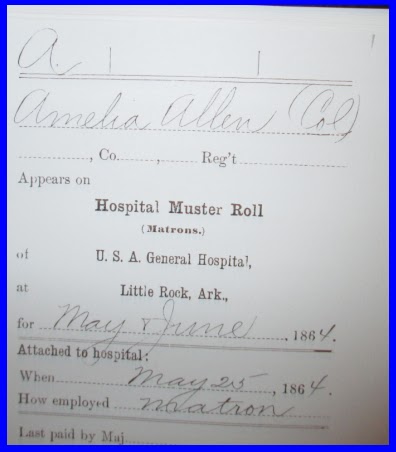
This service card reflects the Hospital Muster Roll 
USA General Hospital, Little Rock Arkansas of Amelia Allen who Served in the 
Union Army Hospital, Little Rock Arkansas, during the Civil War
Source: National Archives RG 94, Entry 535 Box 1

Last July I wrote an article about a ledger that I had located reflecting the service of "Colored Contract Nurses" who served in the American Civil War. In that ledger most of the nurses served in hospitals from Maryland to North Carolina. However I became quite interested in the additional places were women of color worked for the Union Army as Nurses, Matrons, and as laborers including laundresses and cooks.

I later stumbled  upon another set of records by accident. I was looking for a soldier who served in an Arkansas regiment, from the 57th US Colored Infantry. As this is one of my favorite regiments, I was interested in learning how many men in the entire regiment had filed for pensions and received them. I was leisurely scrolling through the regimental pension index when an unusual pension card caught my eye.

As expected there was the name of the soldier, his application number and his certificate number indicating that he had received a pension. It also was noted that his widow later applied for and received a widow's pension. This is common and appears on many cards where the pensioner was survived by a widow. But it was the note at the bottom of the card that struck me as a real find!


This pension index card made a reference to a US Colored Soldier's widow 
who applied for her own pension earned for having served as a nurse.
(Regimental Pension Index, 57th US Colored Infantry, 
Benjamin Moore, Co. B, 57th US Colored Infantry)


Upon seeing that information I had two tasks to complete that day. First I had to learn the name of his widow, as she was not named on the Pension Index Card. Secondly I had to ask whether names of other women who served as nurses could be found. I was successful on both counts!

The Pension file was thick--extremely thick and in the midst of the many pages (well over 150 pages) was a separate set of documents pertaining to Clara Moore. I had found her name, and tucked into his file was her own Pension File.  This is one reason the file was thick. The other reason was that there was a contesting widow who also claimed to be the widow of the same man! (But that is another story to tell at another time.) I was enthralled by having documented a woman of color who served as a nurse in the Civil War

Portion of document from Civil War Pension Claim of Clara Moore, Civil War Nurse

Clara's case was actually no without its complications. The surgeon under whom she worked as a nurse was deceased by the time she filed for her own pension, and there was difficulty in locating evidence of her having served, with the 57th as a nurse. Proving her case turned out to be difficult,  even though there was evidence in the file that she did serve and others made statements under oath of her service. Even very specific data was obtain pertaining to her enlistment and discharge dates were found. And I was please to find a detailed statement from Clara herself who also told part of her story.


I learned as I read through the file, that Clara and her husband later moved to Indiana after the Civil War, and then their marriage ended a few years later. However, both Clara and Benjamin remained in Indiana for the rest of their lives and for whatever reason, never returned to Arkansas.

Could others be found?
My second interest was learning whether more women of color who served in the war could be found and identified.  My task was to spend some time with the military specialist at the Archives, and see if more names could be located.

What a surprise to find that there is a series of service cards, pertaining to Civil War staff, including hospital employees. There are seven boxes in fact of service cards reflecting the service of civilian staff that served in Union hospitals.  I wasted little time, and requested to see these records.

The documents were identified as part of Record Group 94, Records of the Adjutant General's Office. The entry number is 535, and I decided on a recent trip to begin the process of documenting these women. I pulled the first box and began to sort through the many cards.

Label from Box 1 of RG 94, Entry 535.


Since there were so many cards, I decided to  begin a methodical approach to this effort and I began a process that will unfold over the next several months--to document all women of color who served as medical attendants in some capacity during the Civil War. Some had humble jobs as laundresses and cooks, but others worked alongside the doctors and surgeons as nurses and matrons.

So, beginning with the Box 1, and surnames beginning with the letter "A", my job has begun. In most cases women of color were flagged in some way with the letters "Col" or occasionally the word "Colored" spelled out. But their service records were there, and I was fascinated to also see the names of the hospitals where they served, as well. Some were familiar to me, but so many more were not.

Sample of Service Cards of "Colored" Matron 
who worked at Balfour USA General Hospital, in Portsmouth VA


Only looking at the cards, one can see that nurses of color were utilized throughout the nation were wounded needed care.In the cards below, the service of two different women are reflected. They are both called Anna, but one can see that one served in Mississippi and the other in Tennessee.

Service cards of two nurses. On served at the Freedman's Hospital in Memphis 
and the other served at a hospital for Freedmen in Davis Bend, Mississippi.

So my project begins. 

Over the next several months I shall access this collection of service records of Civil War nurses, and record the image of all women of color who served as nurses, matrons, laundresses and cooks.

Like other pertinent stories of the Civil War, these women, most of whom has just tasted the flavor of freedom, gave their all nursing those suffering from wounds, and from disease. 

May their stories also be told and may they never be forgotten!

* * * * *

Thursday, February 21, 2013

As March approaches, the 150th Anniversary of the organization of the US Colored Infantry took place. In honor of this regiment and it's amazing history, this video is shared. The video is part of a five year series provided by the Charles Wright Museum of African American History in Detroit Michigan.

Tuesday, January 1, 2013

A Sesquicentennial Year: Honoring The United States Colored Troops

Recruitment Poster for US Colored Soldiers

This is a milestone year for many reasons. The institution of slavery was beginning to become dismantled. On January 1st of 1863, President Lincoln issued the Emancipation Proclamation. Of course the proclamation was more symbolic than directly effective, however, it was significant nevertheless. But a true stake was driven into the heart of the institution  of slavery, in the spring of 1863, when a Bureau was established to organize regiments of "colored troops" to join the War. The companies formed were to be consolidated into batallions and regiments by the Adjutant General. Non commissioned officers were to be chosen from the men in the various companies.

The year 1863 was significant primarily because men of color were finally allowed to become officially involved in their own quest for Freedom. But they did not enter the war as runaways, they entered it directly as men willing to directly confront their enslavers, and to fight for the right to live as free men. And so it was,  in May of 1863 a mere four months after the Emancipation Proclamation was issued, General Order 143 was released. This order possibly had a greater impact on the lives of the enslaved than any other order during the War.

General Order 143: Creation of the Bureau of US Colored Troops
 War Department General Order 143: Creation of the U.S. Colored Troops (1863)
Source: General Order No. 143, May 22, 1863; Orders and Circulars, 1797-1910; Records of the Adjutant General's Office, 1780's-1917; Record Group 94; National Archives.

With so many commemorative events occurring between 2011 and 2015, it should be understood that one of the most critical years of the Civil War was 1863.

Finally black soldiers were allowed to enter the ensuing battle in their midst.  Although the goal was to preserve the Union for many and for others the battle was to secede and continue life as they knew it - including maintaining enslaving an entire people--for those who were allowed to enlist as Colored Troops, the issue was a simple one.  Theirs was a fight for freedom!

The effort to organize the various units was an enormous one, and by the end of the war there were more than 170 units, and these men comprised more than one tenth of the entire Union Army.

It should be pointed out that most of the enlisted men were "volunteers" enlisting to serve primarily in the War effort. These were designated as "US Colored" soldiers. However, in addition, there were some who were part of the regular army, such as the 5th Massachusetts Volunteer Cavalry, 54th and 55th Massachusetts Colored Infantries, and the 29th Connecticut Infantry.

It is also important to note that there were some units of men of color who had already organized, such as a group in North Carolina, the First North Carolina Colored Volunteers. Also a year earlier, in 1862, in Kansas  two regiments had organized and had seen action against the enemy. The First and Second Kansas Colored had already made a name for themselves a year before the US Colored Troops were organized.. Later these units re-designated brought under the jurisdiction of the Bureau of the United States Colored Troops as well. These men were all a part of a mighty effort of men of color who were true Freedom Fighters.

The enlistment of Black soldiers had a major impact on the families of the enslaved. Men were given freedom upon enlistment, and in many communities, the wives and children of those men who enlisted, often seized the opportunity and also freed themselves, forming communities near some of the Union encampments.These civilians were designated as "contrabands" of war, and many experienced freedom the first time due to the formation of regiments in their vicinity.

The participation of these Black men in the war was notable. They participated in major battles and campaigns from the Atlantic to the western theatre of the war. There were 17 Medal of Honor winners emerged from the US Colored Troops. However, the stories of all of the men who were truly men of courage must be told. The individual stories of the men are surfacing all the time, and finally these heroic freedom fighters are being honored. 


Hopefully as the anniversary of the organization of the various units unfold during 2013, the communities where they were formed will  honor these men! Because of what they did , true freedom came faster. Some paid the ultimate price for that freedom, and their courage should be honored during this sesquicentennial year.
Sgt. Major Christian Fleetwood, Medal of Honor Winner

Sunday, November 11, 2012

In Memory: William A. Gladstone

Image of William Gladstone courtesy of Bennie J. McRae.


It was just shared today that Civil War author and historian William A. Gladstone passed away on Wednesday November 7th 2012.

He was the author of two books about the United States Colored Troops and shared his passion regarding the history of the US Colored Troops with many. I have often used his book as a quick reference when I need to look up the origin of a USCT regiment.

A list of all regiments of USCTs and where they were organized from Gladstone's book United States Colored Troops

His work has also been useful when I need to know the date and site of a Civil War battle involving USCTs.

Index of Battles provides a useful references.

Gladstone's work is appreciated and he will be missed by many in the community of Civil War historians.

Sunday, November 4, 2012

A Black Civil War Matron of Western Arkansas

A Civil War Relief Worker, Identity Unknown

So little is known about the women of color who served as nurses and workers in the American Civil War. Even less is known about those who served as matrons.  These were women who actually supervised the nurses who tended the wounds of the soldiers. Many of the matrons had also served as nurses as situations demanded, and in dire times their duties were not distinct from that of the nurses laundresses and cooks. Most names remain hidden from the pages of history, so when we find them, we need to stop, acknowledge them, and record their names, for they too, made a contribution. For me, today was such a day.

Admittedly, I have been locating the names of  nurses color, for several months, Often while searching for other things, is usually when I find them. However, seeing the names of these women is so rare, that I am compelled to stop, study them and share them.

Their numbers are not large, which makes it even more critical that their presence is acknowledged when telling the stories of the Civil War, because they too were there, and they too served the noble effort in the War for Freedom.

Today was one of those days when I found a name---only one name, but of a woman who deserves to be mentioned: Malinda Sanders, a volunteer with the 11th US Colored Infantry.

Malinda Sanders
Muster Roll document of Malinda Sanders, Matron, 11th US Colored Infantry
Source: National Archives Publication No  M1821. Compiled service records of volunteer Union soldiers who served with the United States Colored Troops: Infantry Organizations, 8th through 13th, 1861-65

Details about her life remain unknown, and data such as her place of birth, enlistment site and life after the war are not stated. In addition, it is clear that even when the service records were being compiled in the years after the Civil War, it was noted that nothing else was retained about her.


The small note on the bottom of the document notes that this was the "only roll on which her name appears."

However, a few facts can be gleaned.  

She was matron of the 11th US Colored Infantry. This unit was organized in Ft. Smith Arkansas, in December of 1863, and was attached to the 2nd Brigade in the District of the Frontier, as part of the 7th Army Corps. The unit remained in Ft. Smith until November of that year when they were then moved eastward towards Little Rock.

Malinda was hired in 1864 during the time that the regiment was based in Ft. Smith. A number of regiments were moving through the area during the months from spring to fall of 1864. She is clearly identified as a civilian and a citizen from the area.

In fairness, I had to also wonder if Malinda could have been a volunteer from the white community. But the realities of the south, of the social norms of the day and standards of the day would answer that question.

The chances of finding a white woman serving as a volunteer in a regiment of black men during the Civil War would have been unthinkable, and the local population would never have allowed such a social taboo to be broken. Even those with Union sympathies would have been to more than cautious to allow a white female to be around so many armed men of color during a time of new found freedom for men who were once enslaved. The social norms of the day would have not permitted it.

But, to be certain I was compelled to check the 1860 Federal census in case there was a woman living in the local community by the name of Malinda Sanders. The 1860 census of the local area in western Arkansas, and specifically Ft. Smith, and Van Buren, (the two communities with large populations) yielded no white females with that name. The same 1860 census also reflected free whites who lived in nearby Indian Territory, and no such name of Malinda Sanders was captured. 

So the chances are strong that in 1864, Malinda Sanders was from the population of newly freed black people, once enslaved in the area. She would  have then been part of the local citizenry and would have been part of the population recruited. A good number of  black men were indeed recruited in the Ft. Smith area, until November of 1864 and during that time was also when Malinda was hired as a matron.

How long did she serve as matron?
Was she a young woman?  
Was she an older woman?
All of these facts remain unknown, and it is possible that by the time that the regiment moved east towards Little Rock, she was no longer in service.

Perhaps her time as matron of this Black Civil war regiment was short, but because her name appeared among the names of the many enlisted men of color who were true freedom fighters on the western frontier, her name must not be skimmed over lightly and remain unseen.  

Her service was needed, her care of those who were sick and wounded was essential, and she will remain one of the many unsung heroes from the Civil War.  

However, on this day, as I passed her name I was compelled to draw brief attention to this brave woman, who served, and whose life will otherwise remain unknown. We owe her thanks as well. 

Tuesday, October 30, 2012

Civil War Portrait Identified

Samuel Smith Family Portrait
Samuel Smith served in the 119th US Colored Infantry
(Colorized by artist Patty Smith)

From the collections of the Library of Congress, one can find a number of images of Civil War soldiers, including images of the US Colored Troops.  One of the more striking images is a family portrait, said to be the only photo of its kind-a black Union Soldier with his wife and children.

The photo appears in many brochures and on many websites, and I was thrilled to see today on Facebook the image once again, but this time with data about the soldier, and his wife and two daughters! The data on the soldier apparently appears in the November 2012 issue of Kentucky Explorer Magazine.  Thankfully an associate on Facebook shared the image with the soldier's name.

Sergeant Samuel Smith enlisted in the 119th US Colored Infantry in Camp Nelson Kentucky. His wife Molle and their daughters Mary and Maggie are pictured in this beautiful photo. Long featured on the Library of Congress website, finally the name of this man and his family are known. He lived most of his life after the war in Rockcastle County Kentucky in the town of Mount Vernon. After the Civil War, he remained in the same community and he is found in the 1870 census with his family. There were other children in the household at that time as well. Although identified as twins, the two girls appear to have been a few years apart in the census record in 1870.

1870 Federal Census, Rockcastle Kentucky, Mount Vernon Township


Samuel Smith and his wife are buried at the Walker Newcomb Cemetery in Mount Vernon, Kentucky. His grave bears a military marker reflecting his service.

Source: Image of Sgt.Smith's headstone on Find A Grave
Headstone image shared by Charles Wilton

Near the original marker, a second marker was also placed for Sgt. Smith.

Source: Image on Find A Grave


Samuel Smith's wife Mollie is also buried at Newcomb cemetery and a headstone also marks her grave.

Headstone of Mollie Smith, wife of Sgt. Samuel Smith
Image Uploaded to Find a Grave by Charles Wilton

I have since learned that the amazing image of Sgt. Smith and his family are part of a private collection that was donated to the Library of Congress. The Liljenquist Family Collection is a fairly recent acquisition to the Library of Congress, and it included the image of the Smith Family. It was donated in 2010 by this family that has been purchasing images of Civil War soldiers for many years. One has to wonder how the image of the Smith family ended up for sale, and how the identity of the soldier was found. Thankfully Sgt. Smith is no longer a nameless face and his family reflected on the image tells so much more about Smith, as a soldier and as a man. 

Needless to say that I shall be researching more about the life of this man and his family, on my next trip to the National Archives.


Thursday, October 11, 2012

The Battle that Put a Theory To Rest

Battle of Island Mound - October 1862
Source: Harper's Weekly

At long last a new historic site is honoring the actions of men who fought at the Battle of Island Mound, in Missouri. And finally significance of that battle is being told. This was a critical event, for it was the first time that Black soldiers engaged in battle in the Civil War.

They were said to have been men of no courage. They were perceived as men inferior in spirit, intelligence and personal strength. It was believed and debated nationally whether they could withstand the pressures of military battle and it was assumed that they would cower in the face of the enemy and flee.

But in Ft. Scott Kansas, with the influx of runaway slaves from the Cherokee Nation, and nearby Arkansas, a growing number of able bodied men were willing to fight with the purpose of eradicating slavery. In the summer of 1862 the Ft. Scott Bulletin wrote about the continued recruitment of black men in the Union Army. So many had doubted the ability of the men to have the emotional and psychological strength to look white men directly in the eye, let alone to engage in combat against them. But General Lane the Ft. Scott officer who oversaw the training wrote in the Bulletin of a dramatic change in the men who were being trained for battle:

"I have seen them come into the camp, looking down as though slaves. By and by they begin to straighten themselves, throw back their shoulders, stand erect and soon look God straight in the face."

The debates continued however, on a national level whether black men would fight in war. It was believed that they would simply drop their arms and flee. Yet, in 1862, on a crisp day in October in Missouri, over 200 men of color put the theory to rest. They fought hard, they fought nobly and they fought with a ferocity that astonished the nation. Like all men, when tested, they demonstrated their strength. And in October 1862, the men of the Kansas Colored many former slaves from Indian Territory, not only stood up to the enemy, but they also won their battle.

This was the first battle of the Civil War in which men of African Ancestry encountered confederate forces and their actions rattled the nation. For the first time, these sons of Africa were no longer viewed as mere novelties from the human species lacking courage, wisdom and integrity. They proved that they were men of strength who fully understood their circumstance, and fully understood the concept of battle. They were fighting for their Freedom and on that day in October, the 1st Kansas Colored defied all odds. 

It should be noted what exactly happend at Island Mound Missouri that day. Mere foot soldiers fought off confederate cavalry. The Kansas Colored lost eight men in that battle. But the enemy lost three times that number.  The fact that black men on foot defeated men on horseback rocked the nation to its core. Those who believed in some inbred inferiority of men of color had to adjust their minds to a new perception--that these men were equal to them.

The performance of these brave black men, hastened the eventual establishment of the Bureau of Colored Troops the following year. It was clear that when given the chance they would not only stand up to the task, but some were willing to die for the same values held by all men and women--freedom.

Now, at long last, a new historic site honors the history of the men who changed history on that day.
An interesting 3 minute animation video also reflects what happened that day in Bates County Missouri. (The video loads slowly but it is worthwhile to watch for the full 3 minutes.)

The courage of  the 1st Kansas Colored was the beginning of a major effort that would change the nation forever.
* * * * *
"Once let the black man get upon his person the brass letters, U.S., let him get an eagle on his button, and a musket on his shoulder and bullets in his pocket, there is no power on earth that can deny that he has earned the right to citizenship." 
~~ Frederick Douglass~~